
August 25, 2026, 10:30 AM - Familiar fins of various sizes!
With the full fleet out and about, it was time to spread out and begin searching the Salish Sea. None of our whales have trackers or tags, so every trip is a new adventure! Heading out into the northern part of our range, the boats began travelling in slightly different directions. Keta continued north along Vancouver Island’s coast, Kula went further out along the edge of the outer Southern Gulf Islands, and Cascadia continued through the middle of the Strait.
This spread led to each boat having its own separate encounter with their own separate solo whales!
Cascadia was the first vessel to locate a whale, and this one was busy skimming along the surface as it went. This individual did not raise its tail at all, so we could only photograph its dorsal fin. Usually, we use the underside of their flukes to confirm IDs, as this pattern (along with scars, notches, or other visible anomalies) is as unique to each humpback as a fingerprint is to a human. Dorsal fin identification is a bit harder to do and is usually a bit less accurate, as dorsal fins can change quite dramatically as they become damaged and often do not have as many noticeable identifying features as flukes. At this time, we have not confirmed this little one with any particular whales in our catalogues, but we hope that as we continue to dig through our catalogues, we are able to identify them in the future.
At nearly the same time, Kula’s whale was spotted travelling and fluking as they dove. This unique tail belonged to Beak (BCX1606), the 2014 calf of Big Momma (BCY0324). Big Momma is one of the most famous humpback whales in our area, with 20 known direct descendants in her family tree:
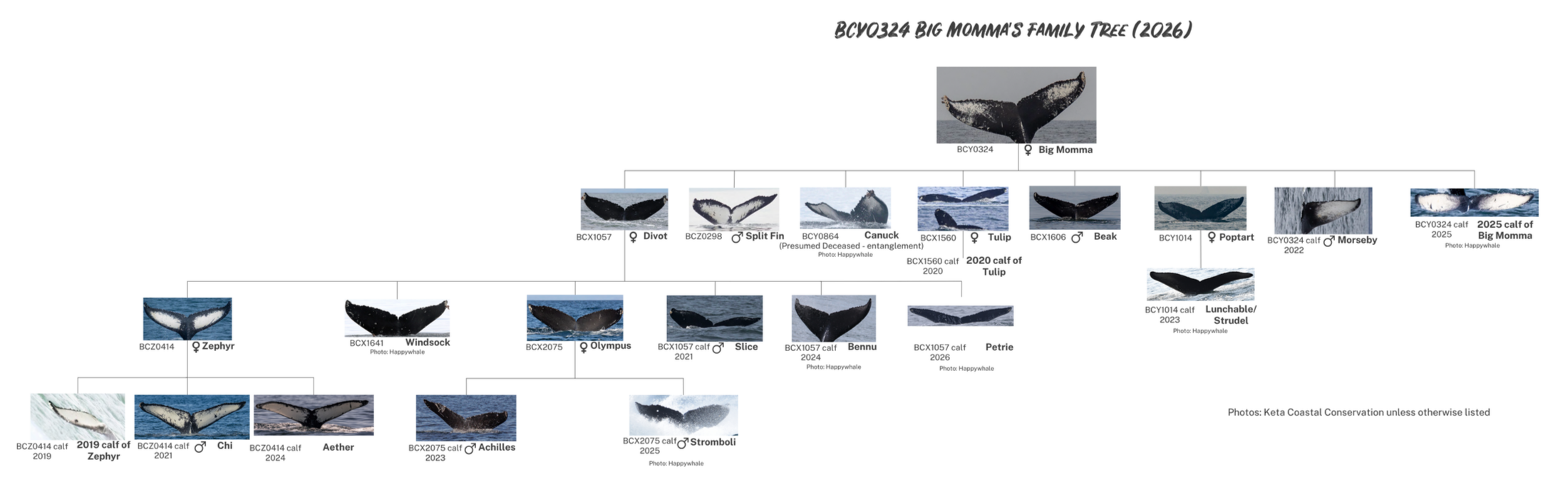
Big Momma’s Family Tree
This family legacy feels extra special when you consider the darker history of humpbacks and other whales in the 1900s. Whaling was once common throughout the Pacific Northwest, and humpback whales were among the species most heavily targeted because of their high fat content. This fat, also known as whale oil, was used in the production of all sorts of items, from soaps and lard to lubricants. The baleen plates that line the roof of the mouth of humpbacks were also prized, as baleen is incredibly flexible yet strong, and was used for items such as carriage whips and corsets. Thankfully, commercial whaling ended, and the population has since rebounded, with whales like Big Momma leading the charge!
Near North Nanaimo, Keta got into position and began documenting a young whale of their own. Judging by their size, it was believed that this was a yearling, or a young whale on its first year of life travelling without their mother by their side. While the little whale did fluke, they did so very shallowly, offering only the briefest peeks at the trailing edge and underside markings before sinking back into the depths. These details didn’t immediately match any of the whales in our catalogue, but after a bit more sifting, we confirmed this whale to be Wolf Eel’s 2025 calf (BCY0940calf2025). Interestingly, their fluke shape ended up being one of the biggest ID clues for this individual. Both sides have a fairly deep bend to them, similar to the shape of a bird in flight. Comparing this to photos on our July 14th blog, including a few visible edge scars, we were able to confirm their ID:
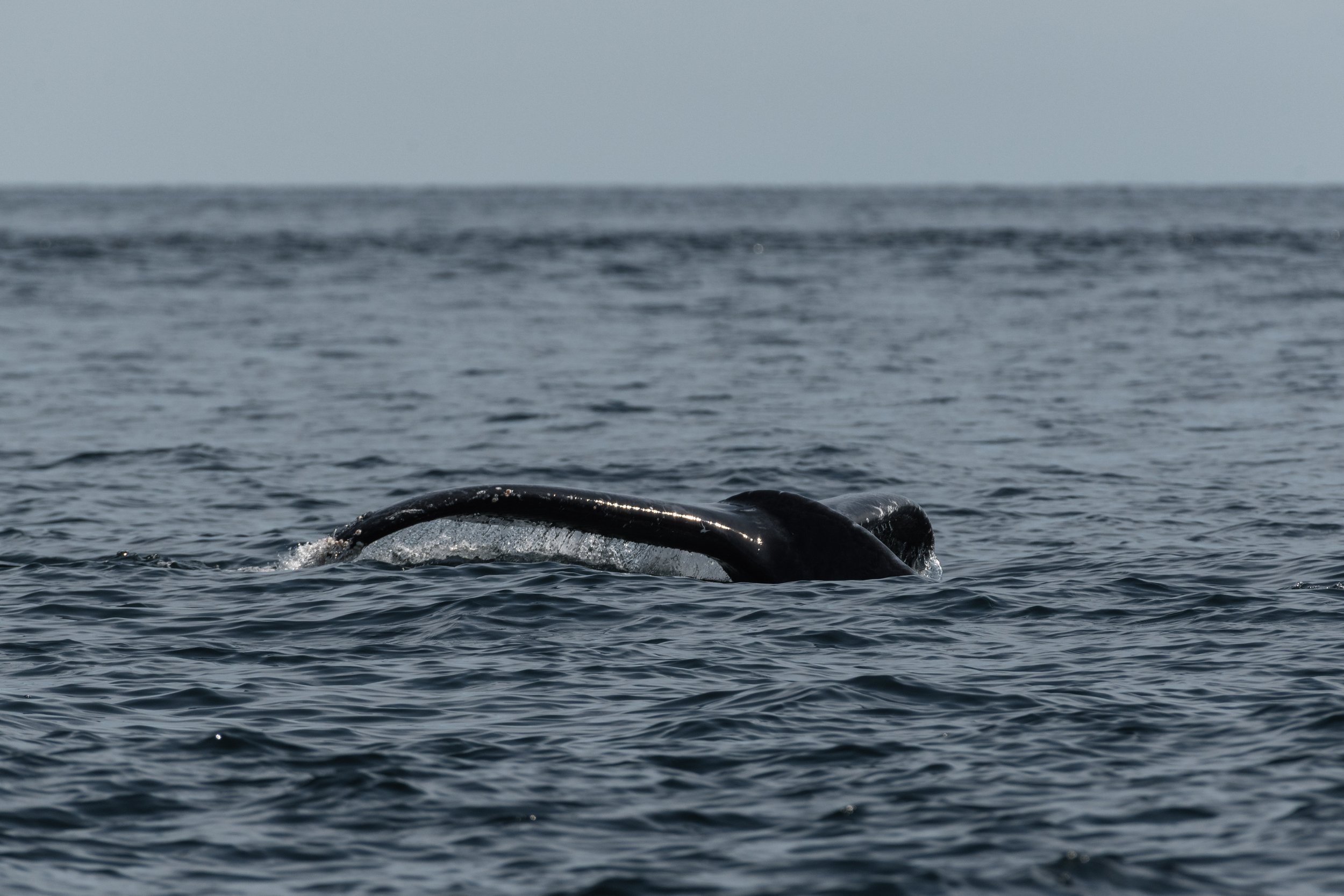
Wolf Eel’s 2025 calf surfacing, July 14 2026 (Photo by Hayleigh Hilbert)
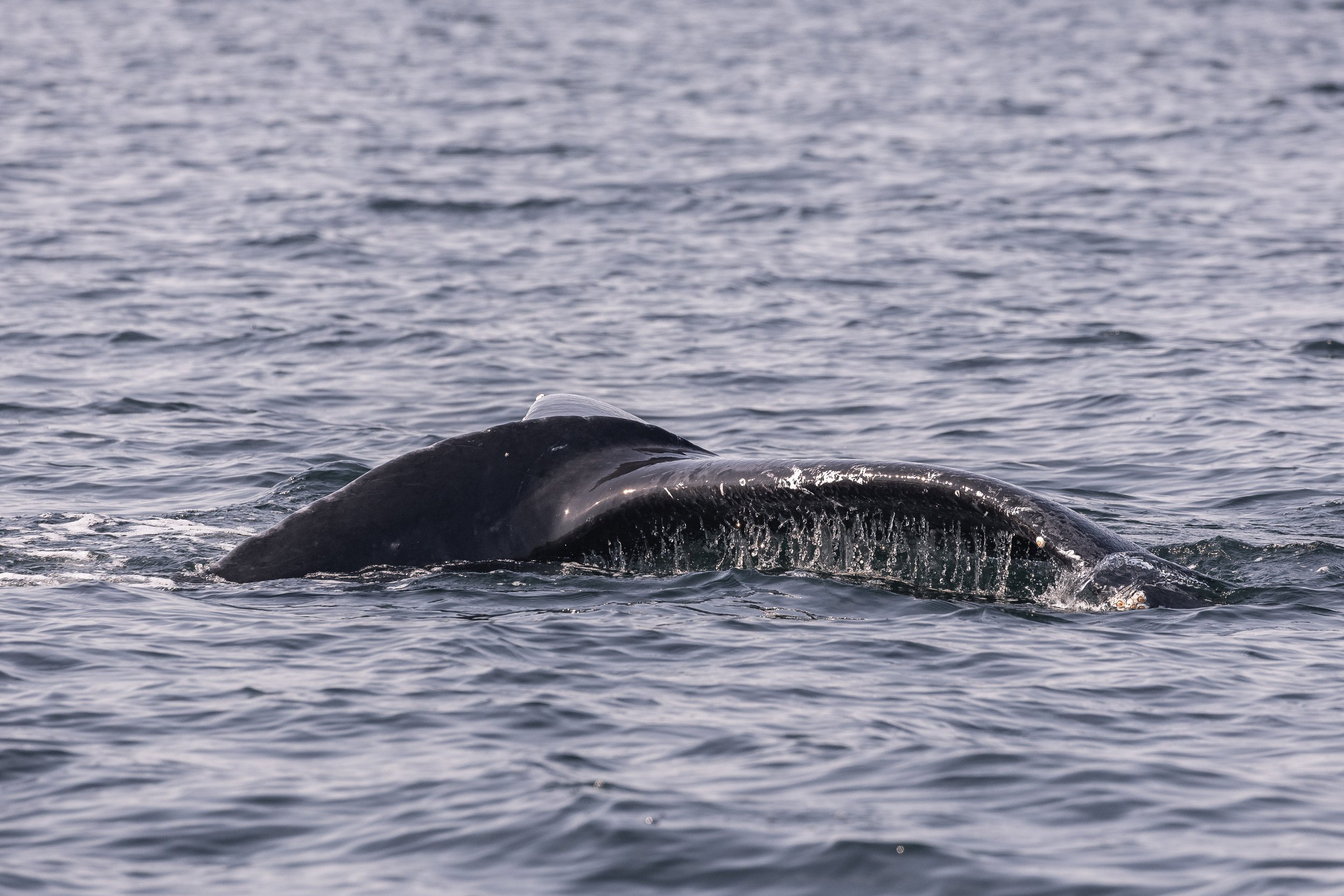
Wolf Eel’s 2025 calf fluking, August 25 2026 (Photo by Jordan Robinson)
After spending some time with these three, we continued onward. We were eager to continue peeking around and hopefully get a view of the other most commonly spotted whale species in the area - orca!
Making our way back into the Southern Gulf Islands, we scanned and scanned along. We headed into Stuart Channel, and soon, we found several small black fins racing along side-by-side. We got into position, and we began grabbing photos of all of them. After comparing these shots to our catalogues, we learned that it was the T046Bs:
T046B Raksha ♀ (1988)
T046B2 Akela ♀ (2008)
T046B2B Takaya ♀ (2023)
T046B3 Sedna ♀ (2011)
T046B3A Munro (2025)
T046B4 Quiver ♀ (2013)
T046B6 Sol ♀ (2019)
T046B7 Tala (2023)
T046B8 Pi (2026)
For a Transient orca matriline, this family is absolutely massive! Most Transient matrilines start separating by the time they reach 6 or 7 individuals. At this point, the family has 9 members, with four under age 4. That is a lot of young calves to feed and teach!
These whales were being very sneaky today, skirting very close to the shoreline as they went. They kept coming in close, scaring the Harbour Seals on top of them, before sinking back into the murky waters. It is possible they were training the calves how to successfully make their way sneakily up to prey before nabbing them. While we didn’t witness a successful hunt while they were tucked close to the rocks, matriarch T046B Raksha moonwalked, or swam backwards and ended with her head above the surface. We sometimes see this behaviour when they prey share with each other, so it is possible they made a quick hunt further out while underwater, out of our sight.
After spending some quality time with the pod, we started slowly making our way away. The day was still young, and we were excited to see what else we could find. Nearby on Norway Island, Turkey Vultures perched atop the rocks. While not the most aesthetically pleasing birds, vultures are critical to keeping the environment healthy and clean. Over the water ahead, a pair of Belted Kingfishers darted by, chittering away.
Along the outer edge of the Gulf Islands, near Valdes Island, was a haul-out cheekily referred to as “Stinky Rocks”. Here, many Harbour Seals and Steller Sea Lions rested, taking full advantage of the summer warmth. Haul-outs like this are critical for pinnipeds to be able to rest and recuperate after spending time and energy in the frigid ocean, hunting and avoiding predators. We continued our way along, chattering about the wildlife as we went, before departing and slowly continuing on our way.
Outside the harbour, there was one last stop in store. Cruising along the shores, we made our way over to the Gabriola Bluffs. The rocks were covered in glistening black birds known as Cormorants, with many of them lined up in a row, chattering to each other. Peeps and squawks could also be heard from a nearby pair of Gull chicks, eagerly looking for their next meal from their parents.
Soon it was time for us to head back into the harbour. Our captains expertly turned us once more, and after a few more minutes of gliding along, we were back in Nanaimo. It had been an excellent time with many unique encounters throughout!
Photos by Marine Naturalists Val Watson, Aly Kohlman, and Jordan Robinson - please enjoy!
The Unknown
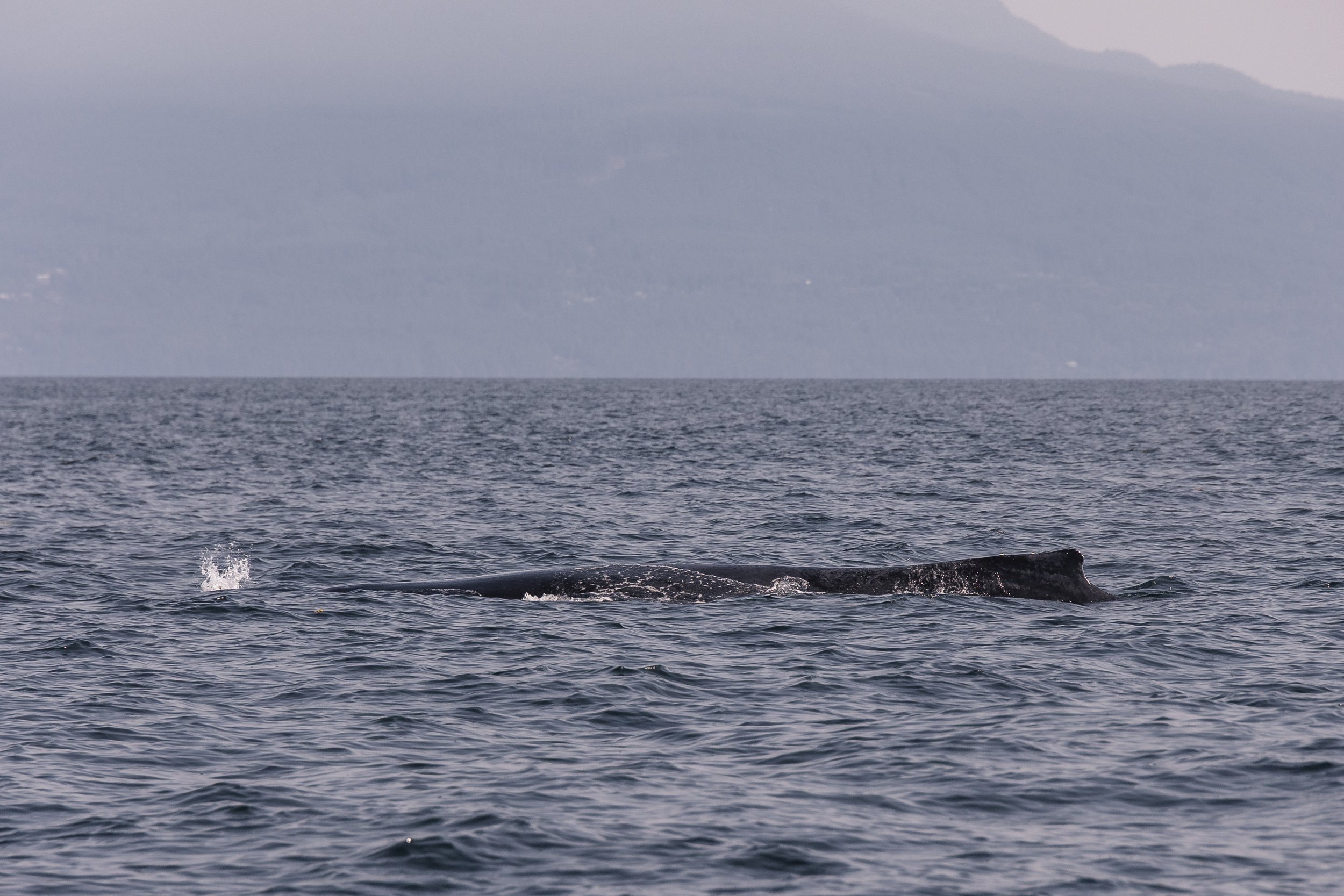
Our fluke-shy Unknown humpback. Photo by Val Watson.
Beak (BCX1606)
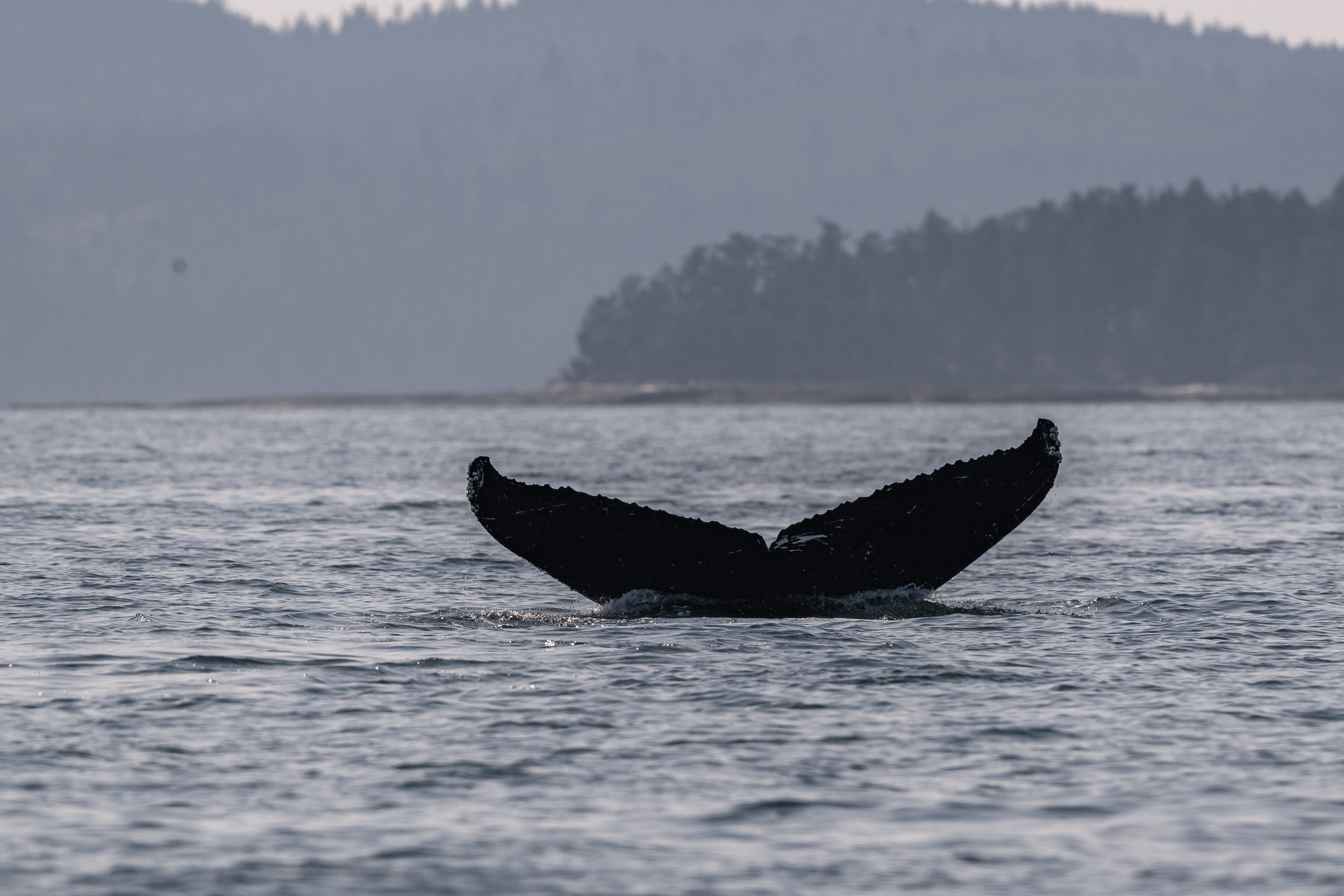
Beak fluking in the distance. Photo by Aly Kohlman.
Wolf Eel’s 2025 calf
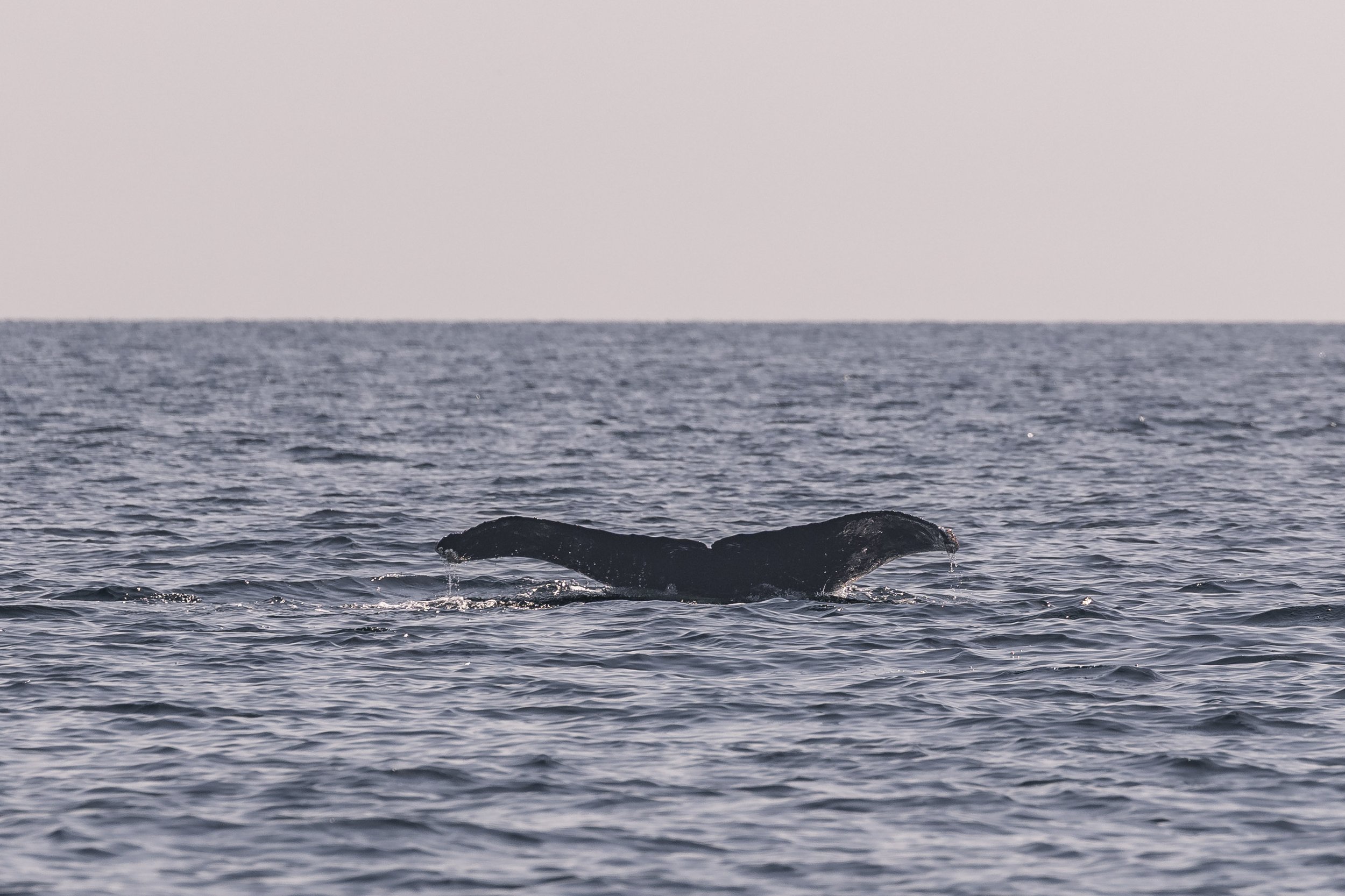
Wolf Eel’s 2025 calf fluking. Photo by Jordan Robinson.
The T046Bs
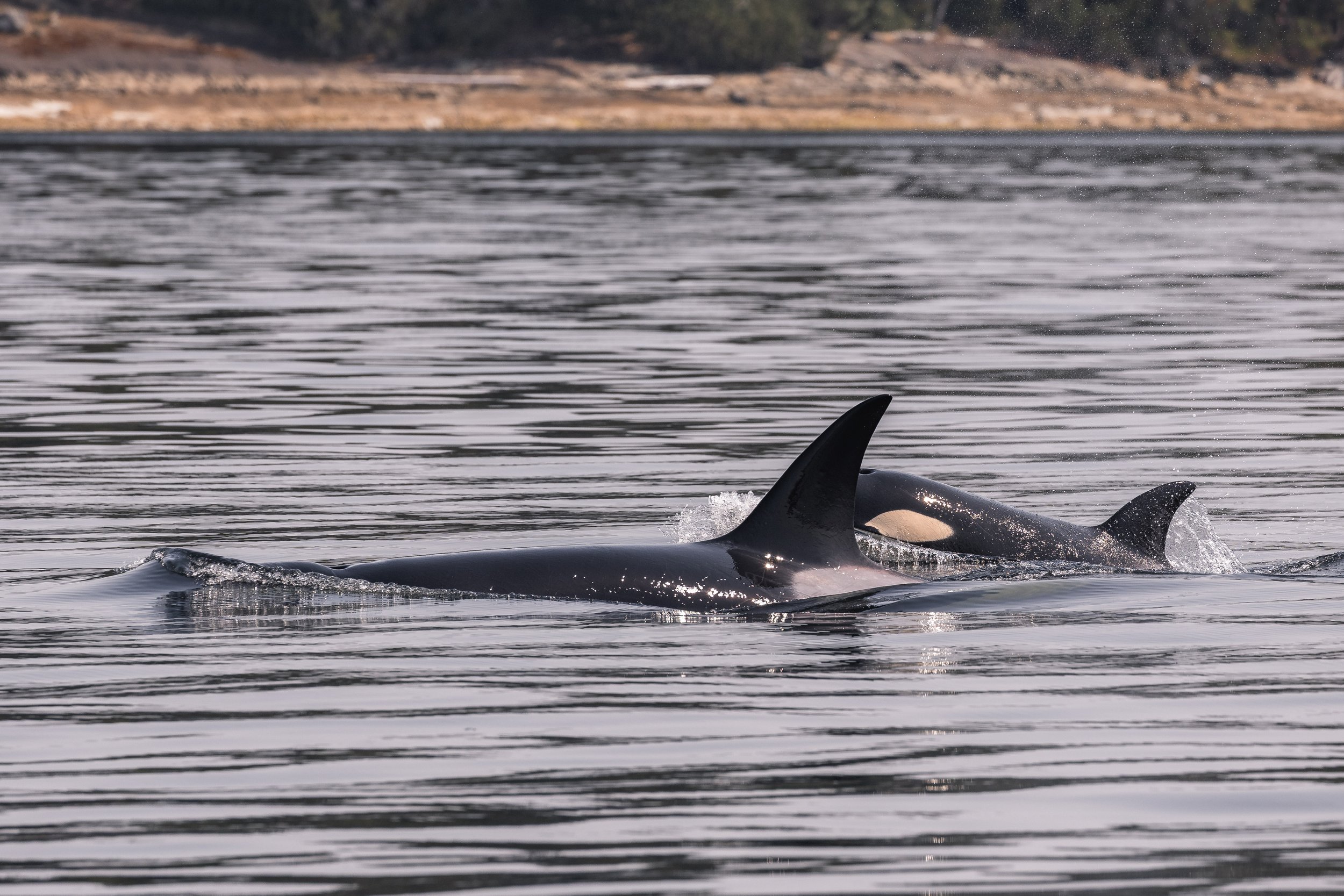
Photo by Jordan Robinson.
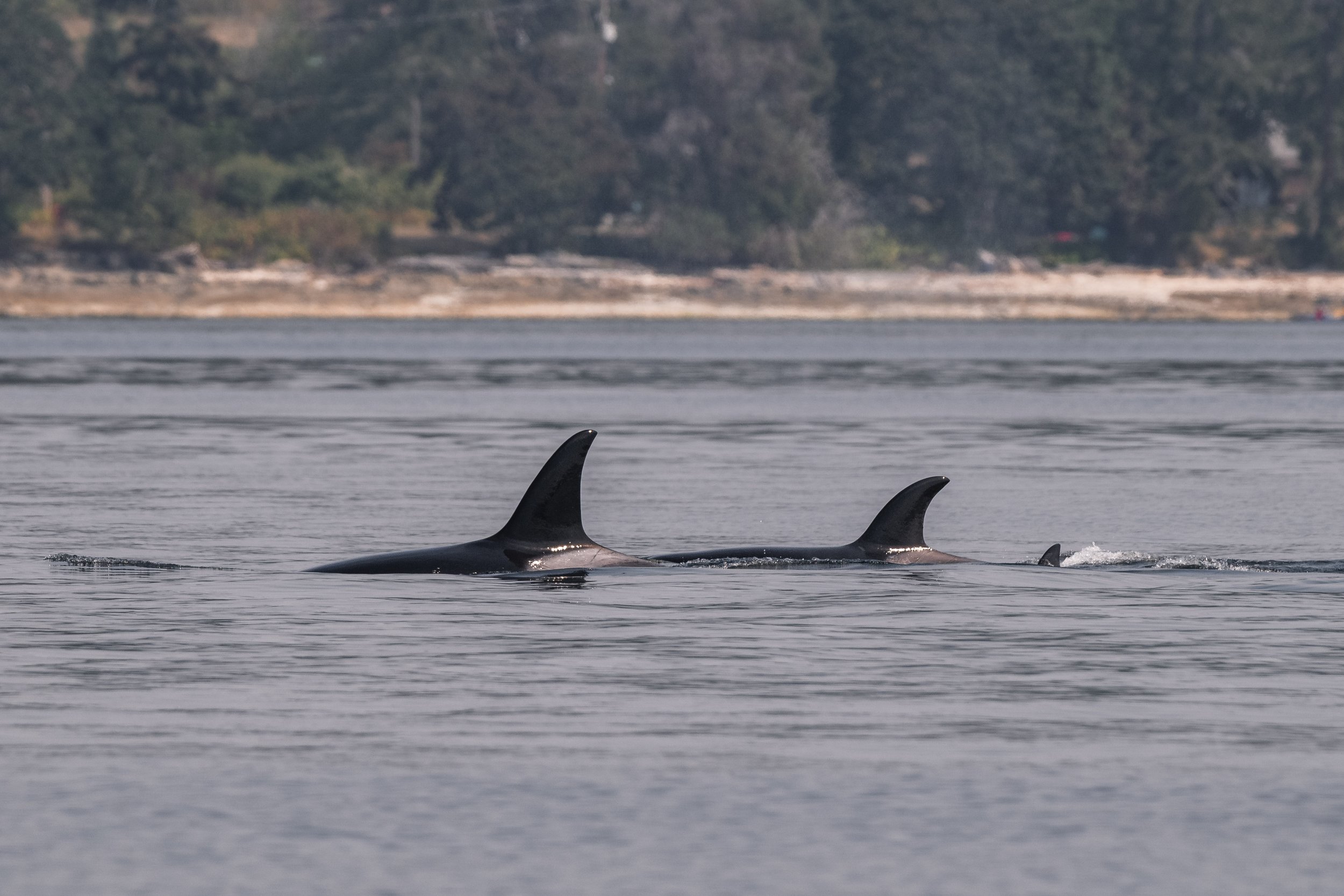
T046B Raksha and T046B6 Sol. Photo by Aly Kohlman.
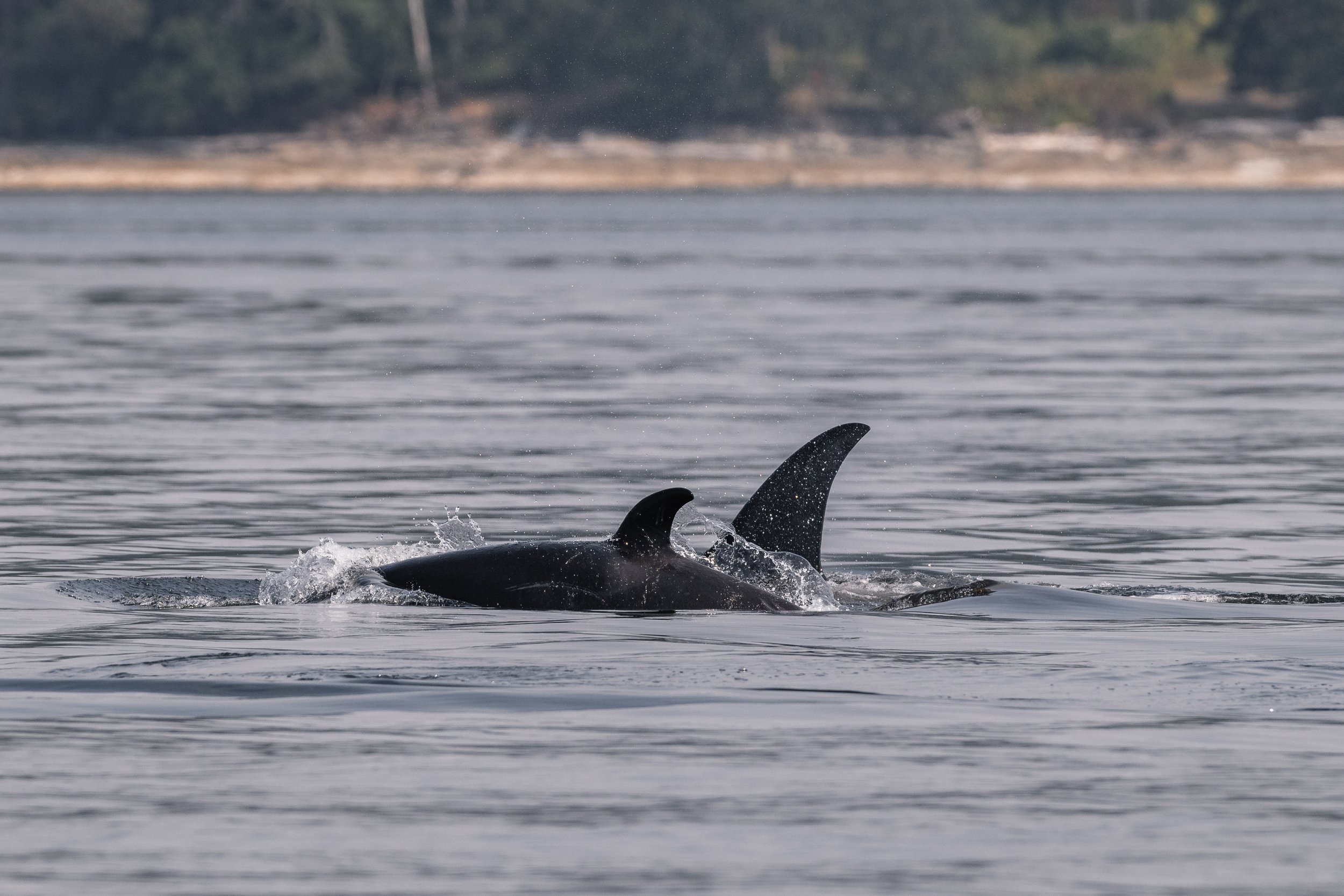
Little T046B8 Pi beside their mother T046B Raksha. Photo by Aly Kohlman.
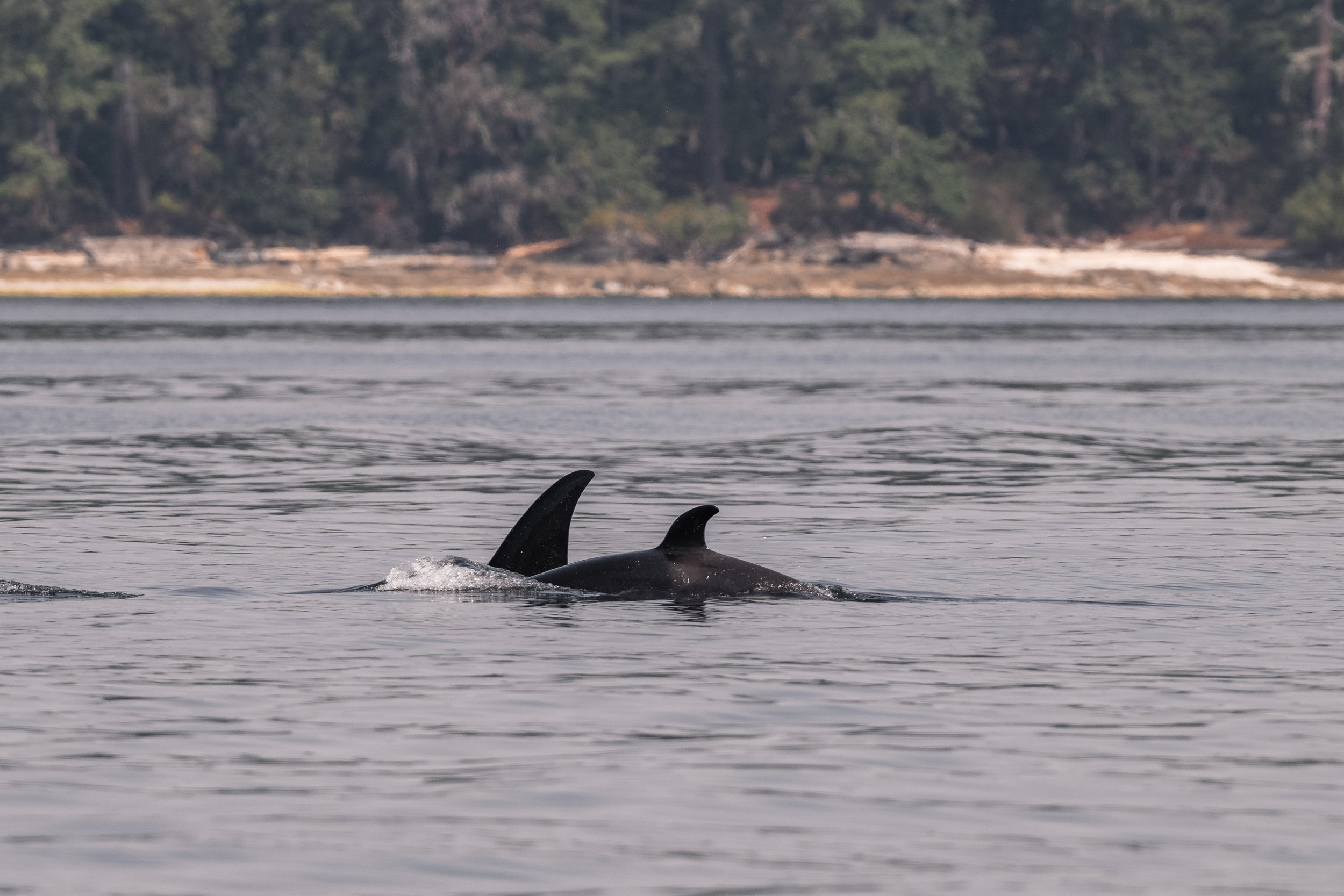
Tiny little T046B8 Pi racing to keep up with mother T046B Raksha. Photo by Aly Kohlman.
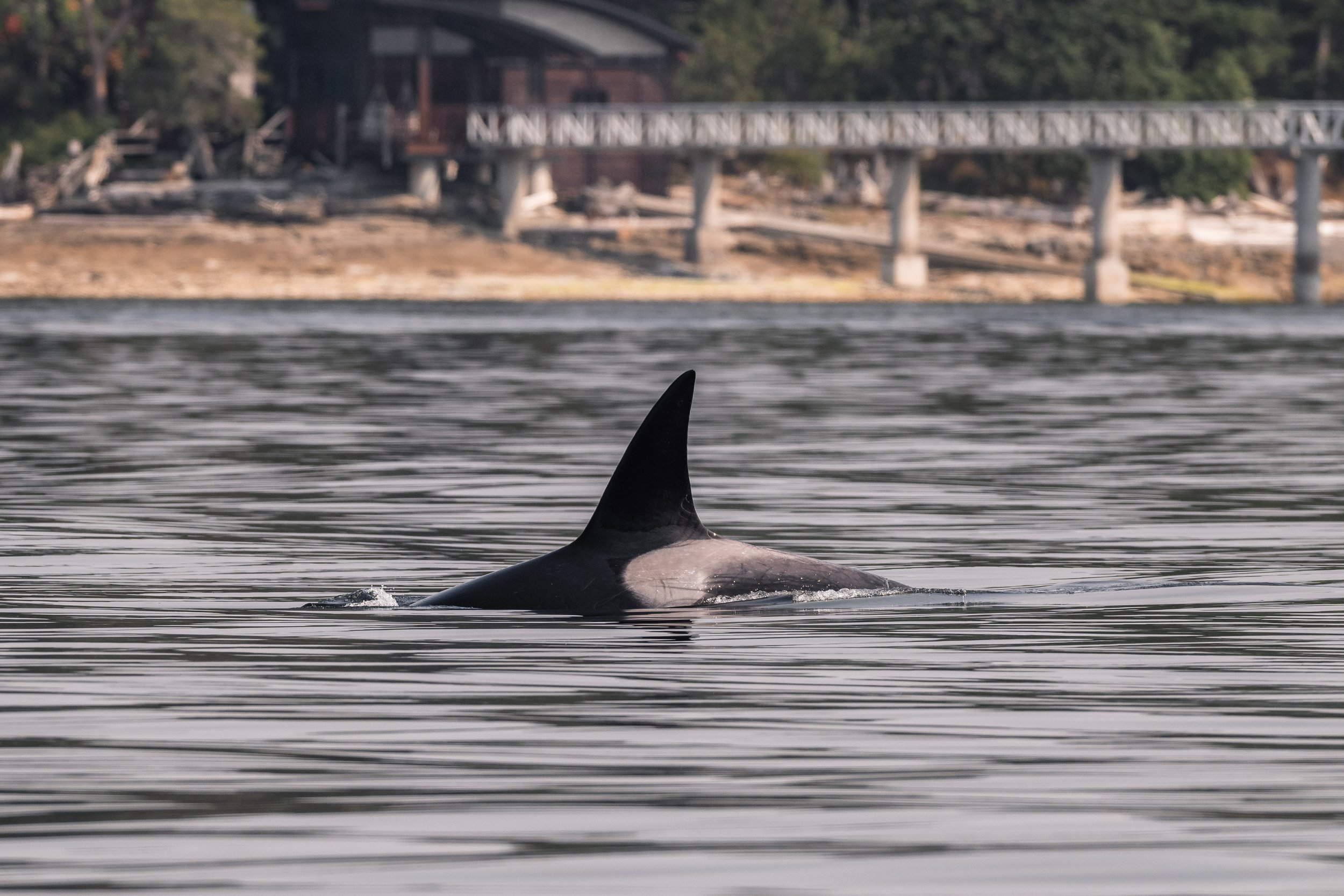
T064B4 Quiver. Photo by Aly Kohlman.
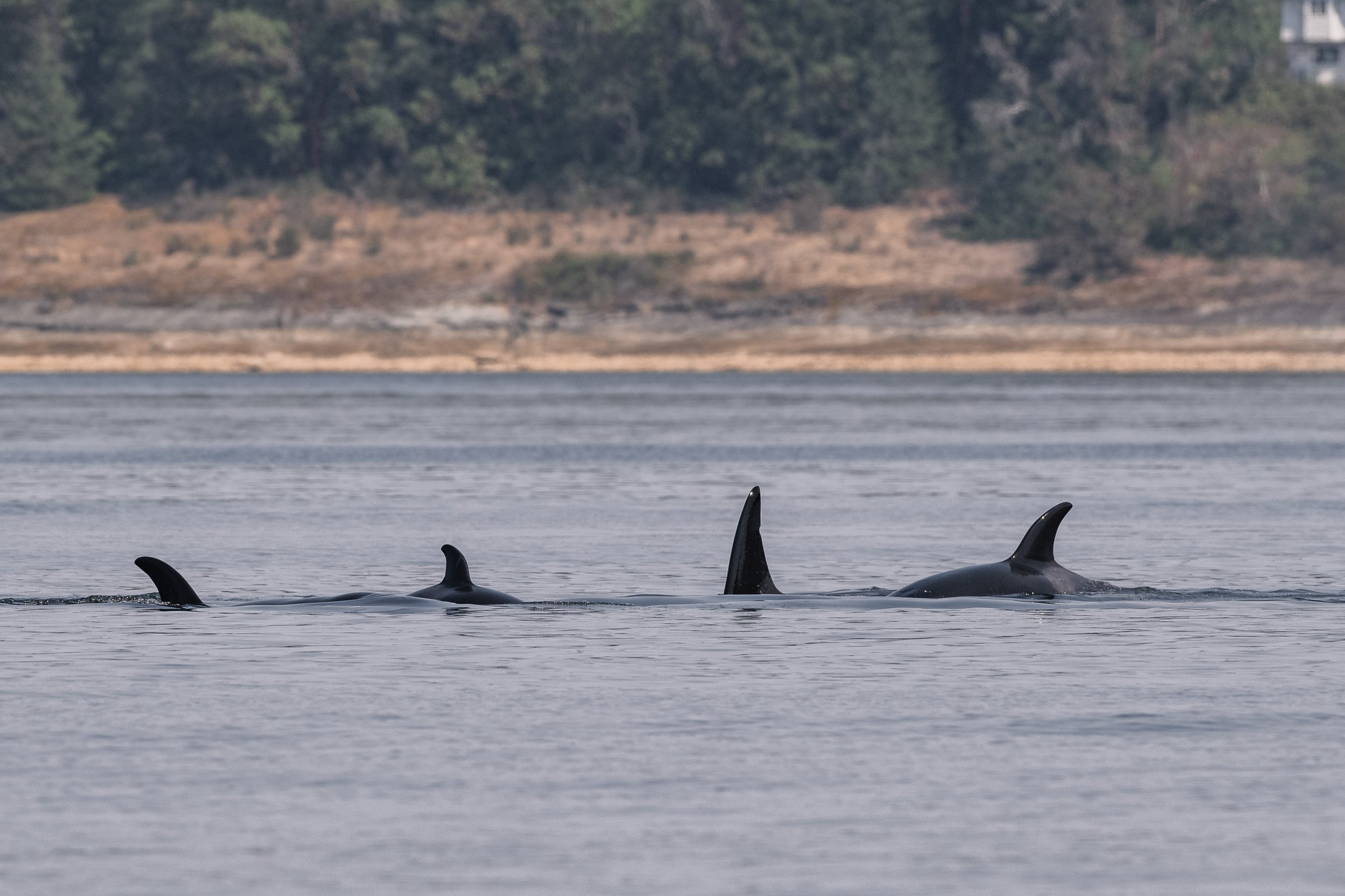
T046B6 Sol, T046B8 Pi, T046B2 Akela, and T046B2B Takaya. Photo by Aly Kohlman.
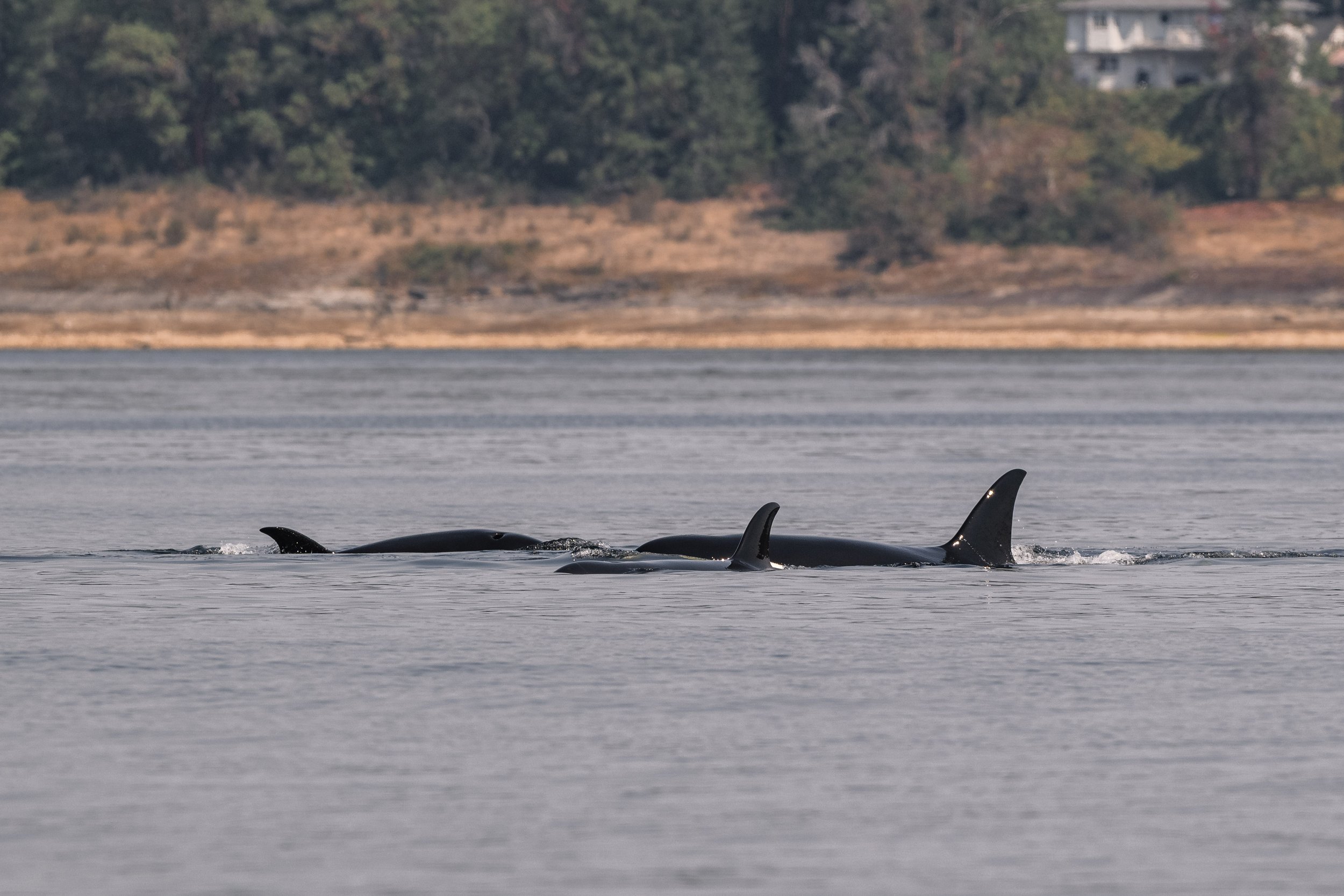
The family was travelling close together today! Photo by Aly Kohlman.
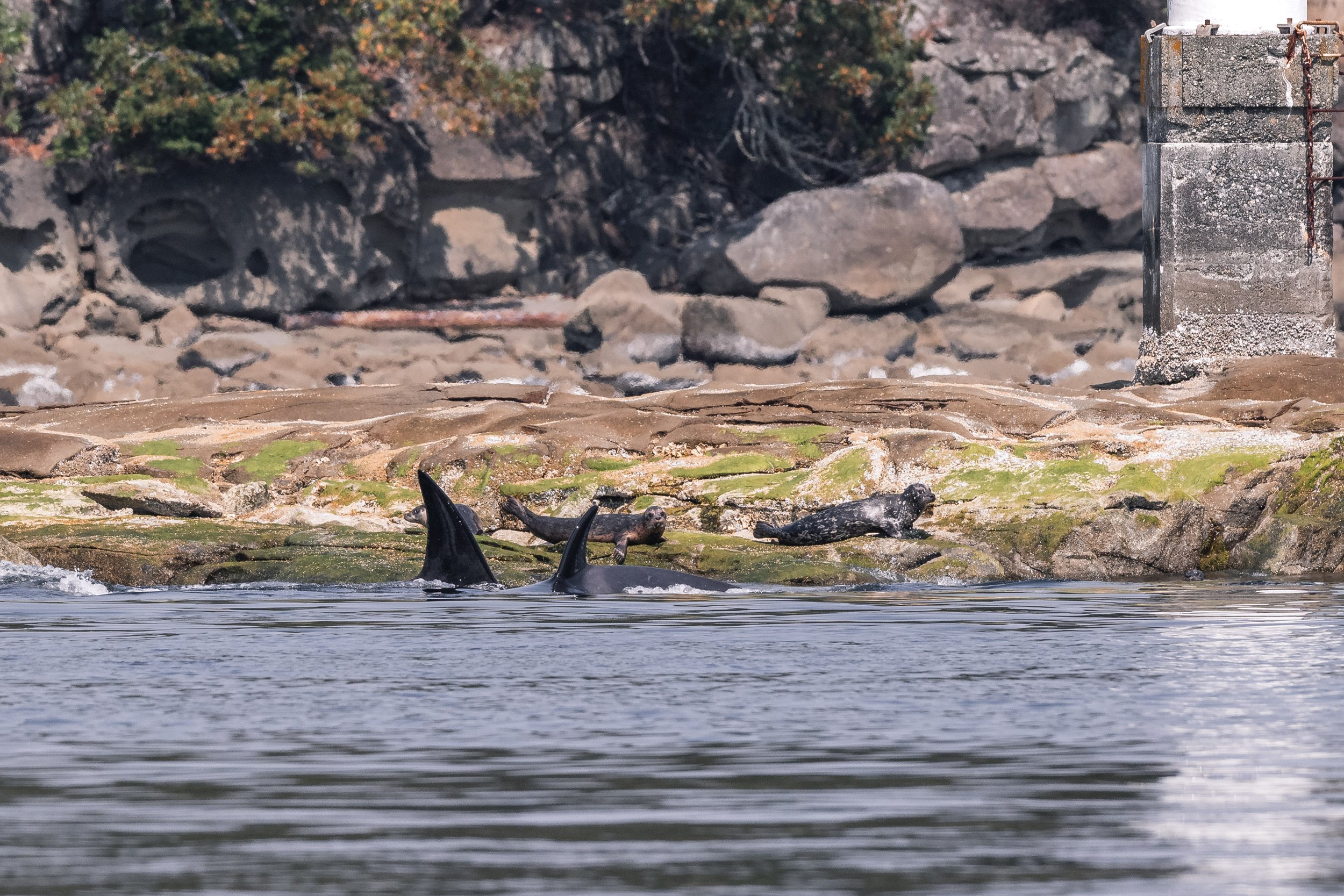
T046B4 Quiver with T046B6 Sol coming in close to scare the Harbour Seals. Photo by Aly Kohlman.
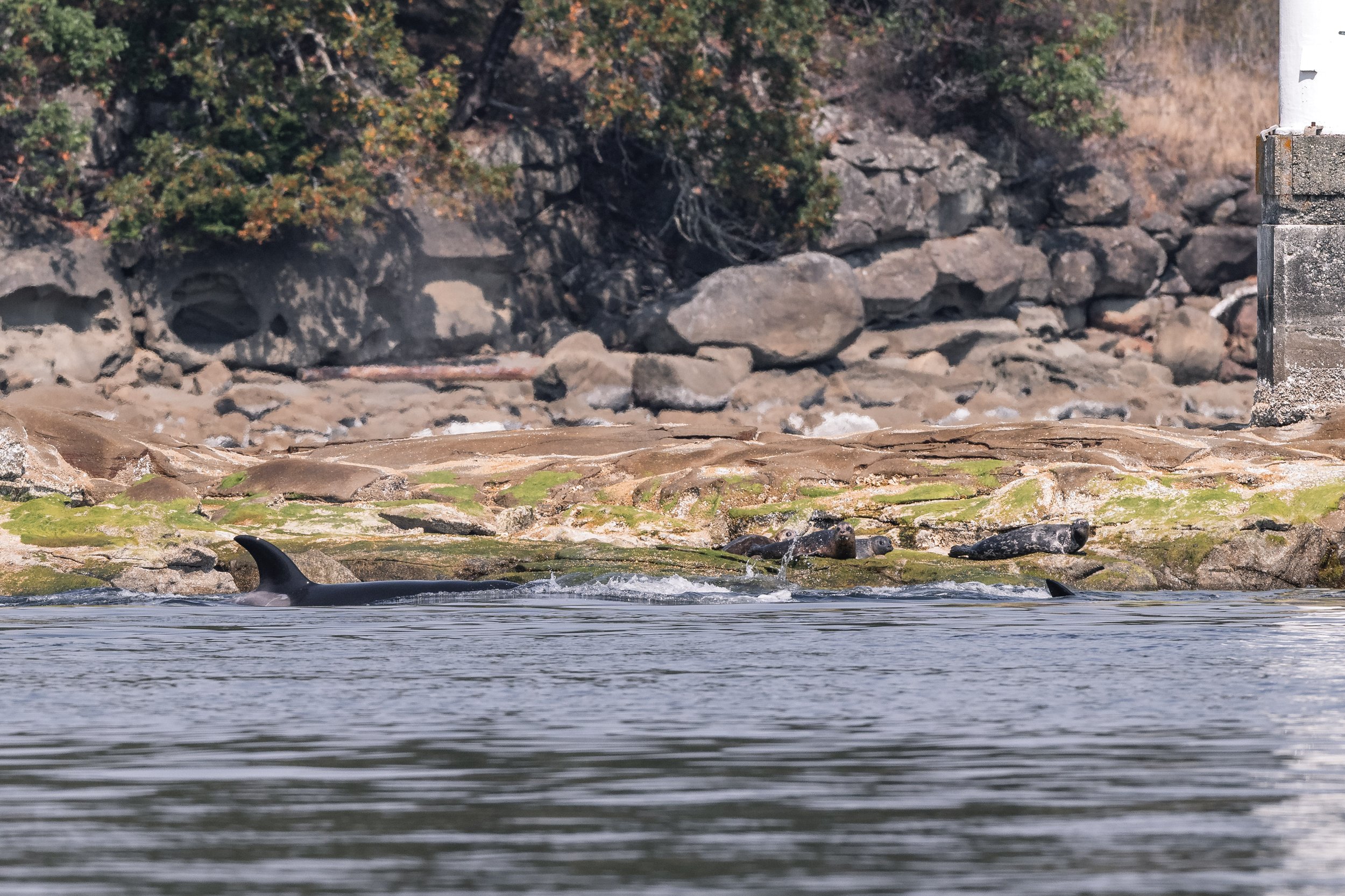
This shot gives us “Jaws” vibes… Photo by Aly Kohlman.
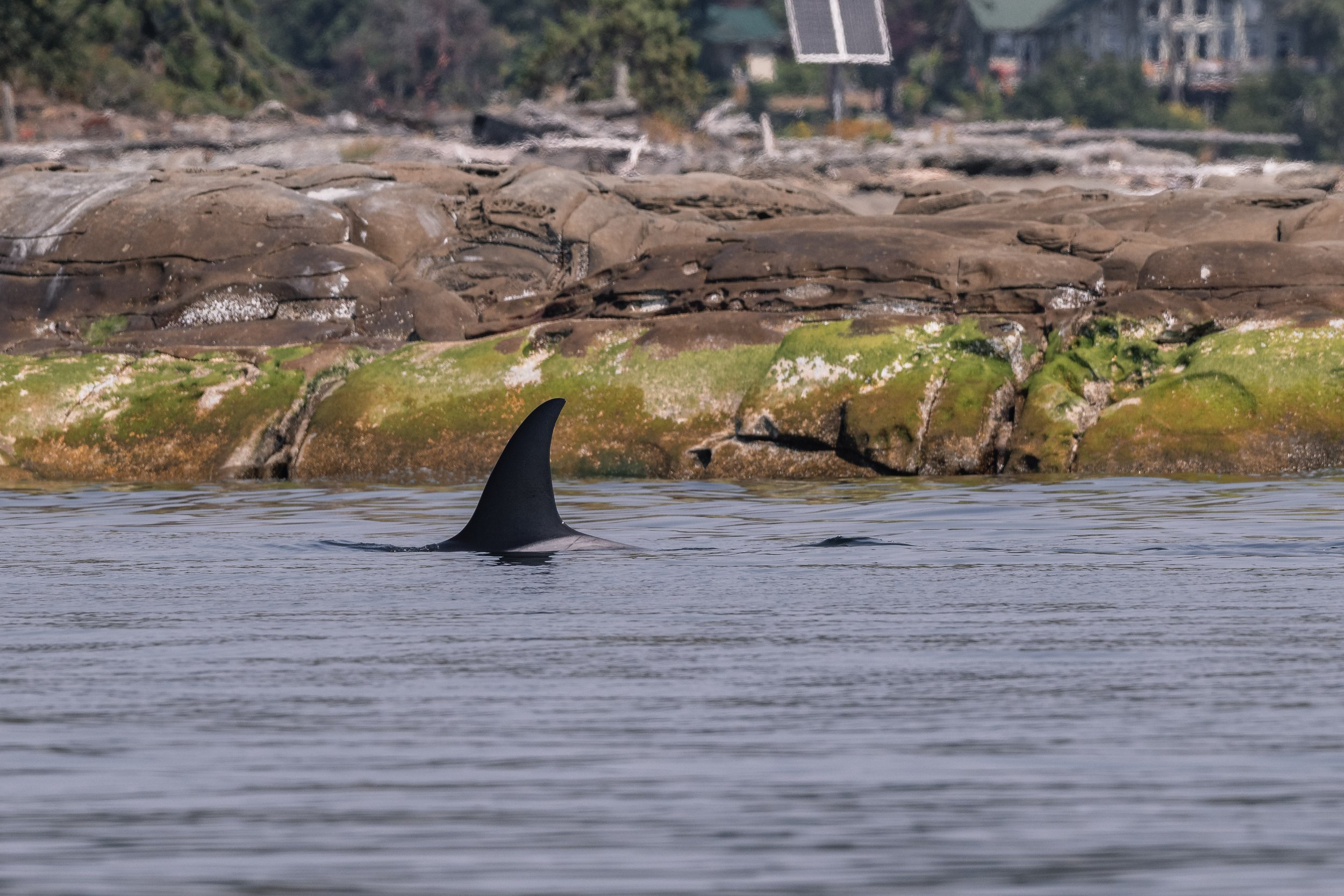
T046B Raksha scoping out the area. Photo by Aly Kohlman.
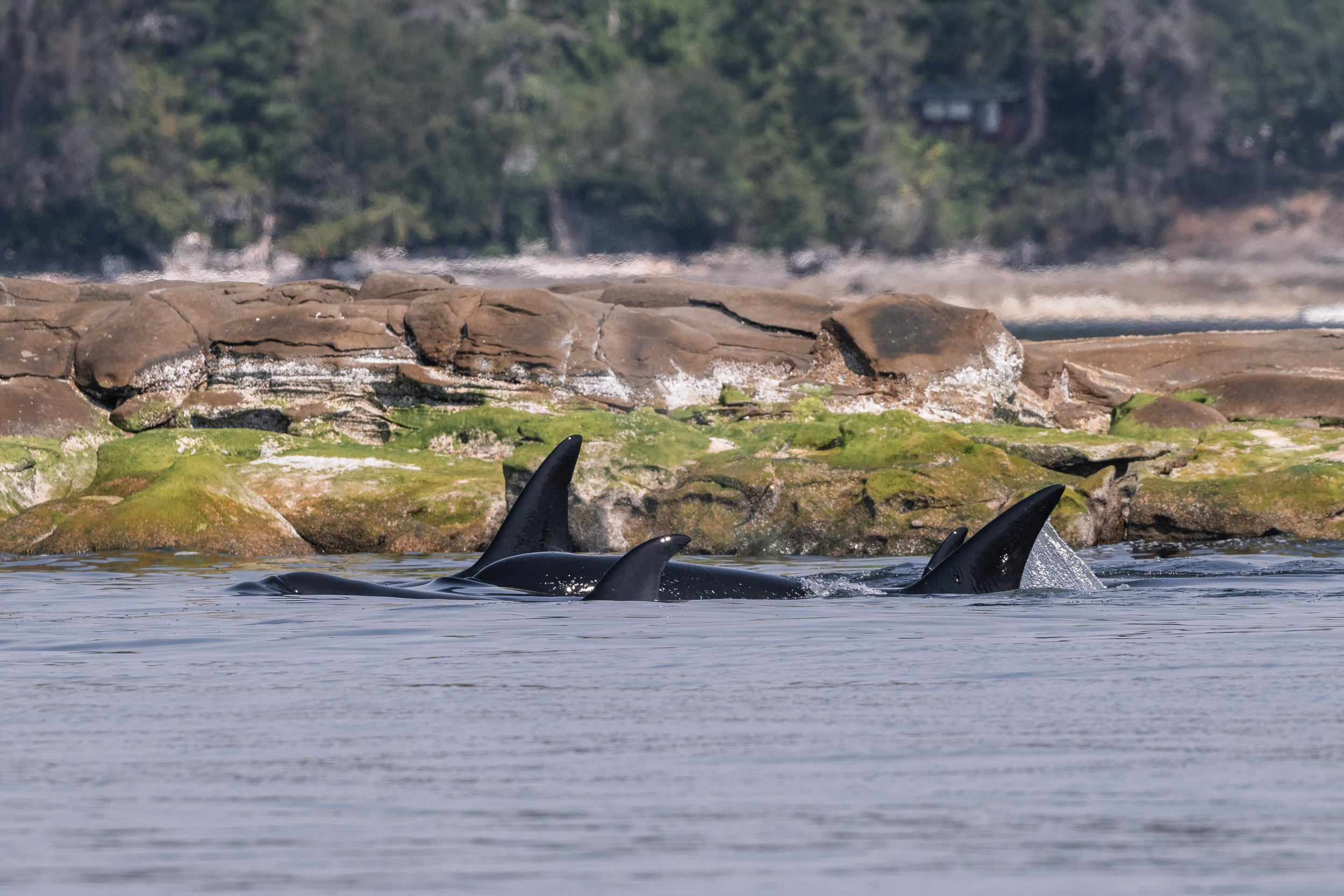
T046B2 Akela, T046B6 Sol, and T046B4 Quiver. Photo by Aly Kohlman.
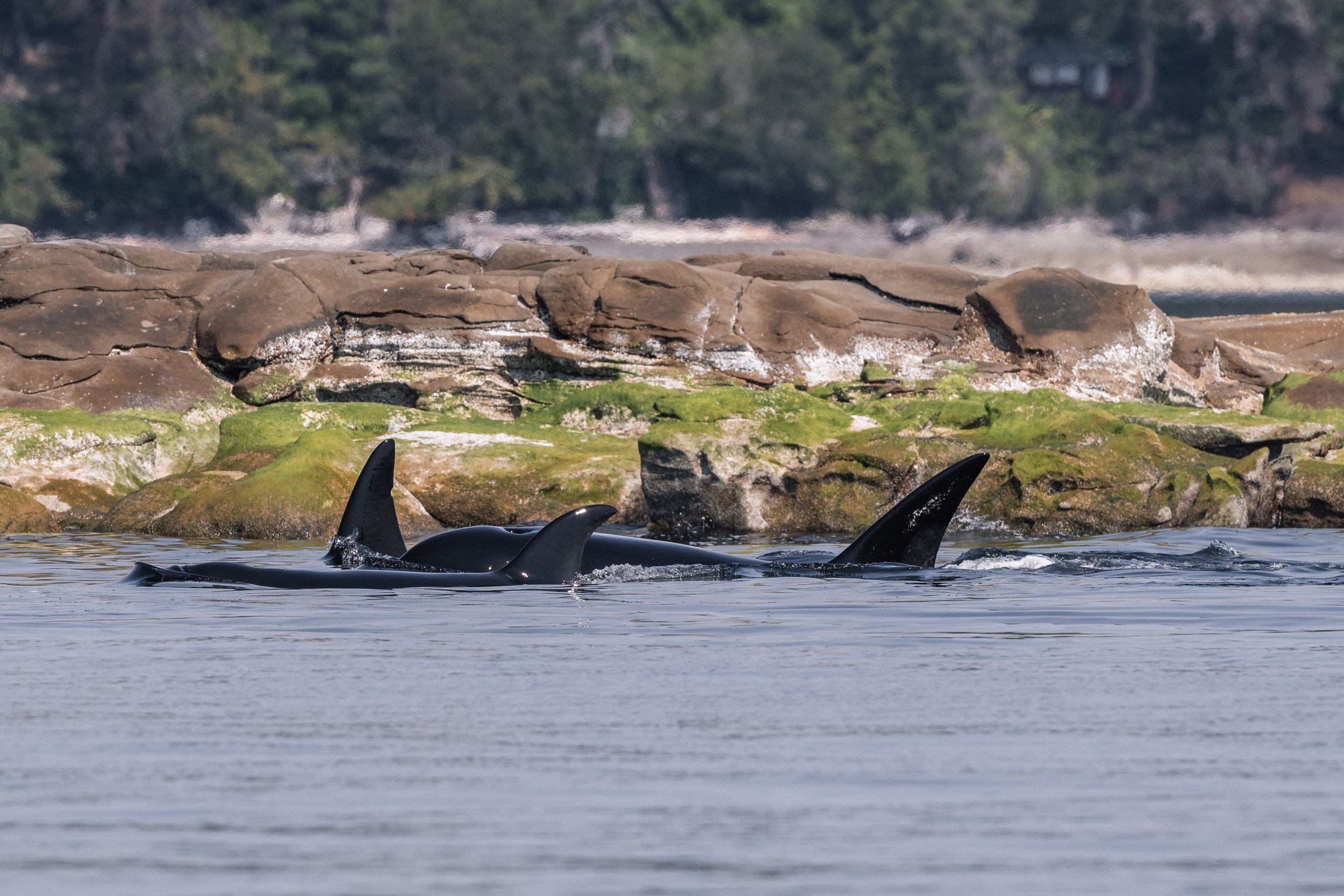
The siblings were working closely in tandem as they sweeped by the rocky haul outs. Photo by Aly Kohlman.
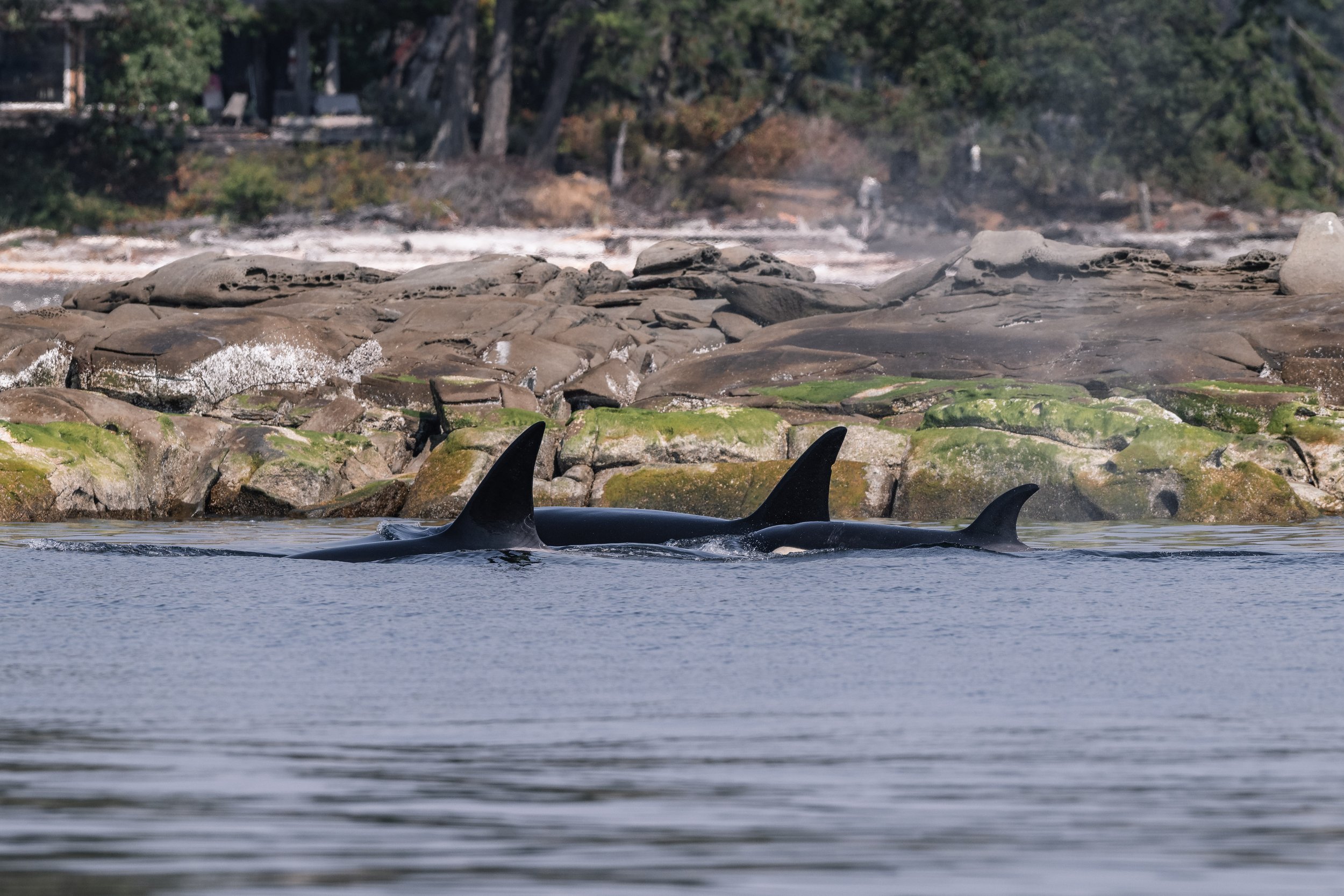
T046B4 Quiver with T046B2 Akela and T046B2B Takaya. Photo by Aly Kohlman.
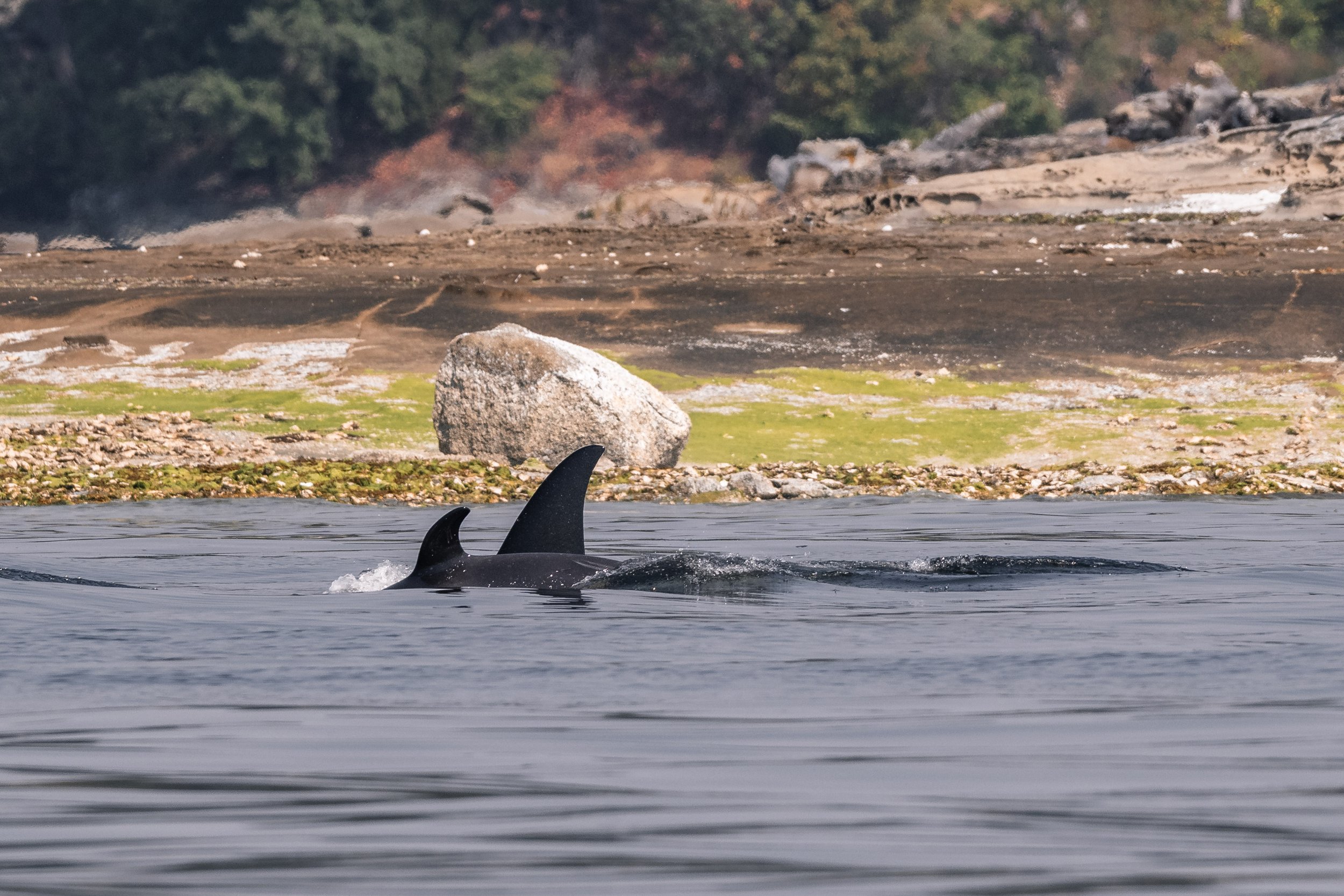
Tiny T046B8 Pi beside their mother T046B Raksha. Photo by Aly Kohlman.
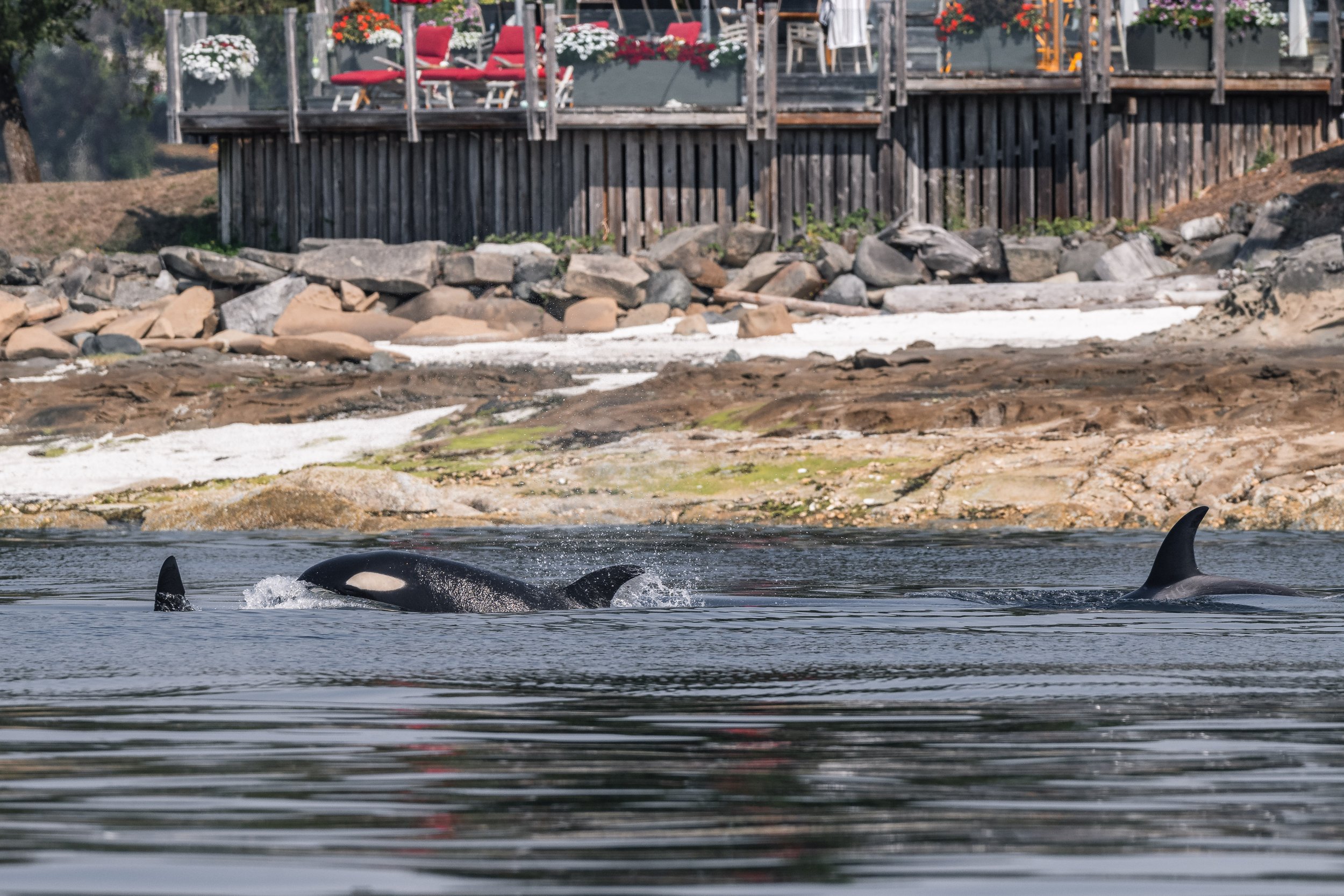
T046B2 Akela with her calf T046B2B Takaya behind her, and T046B6 Sol behind them. Photo by Aly Kohlman.
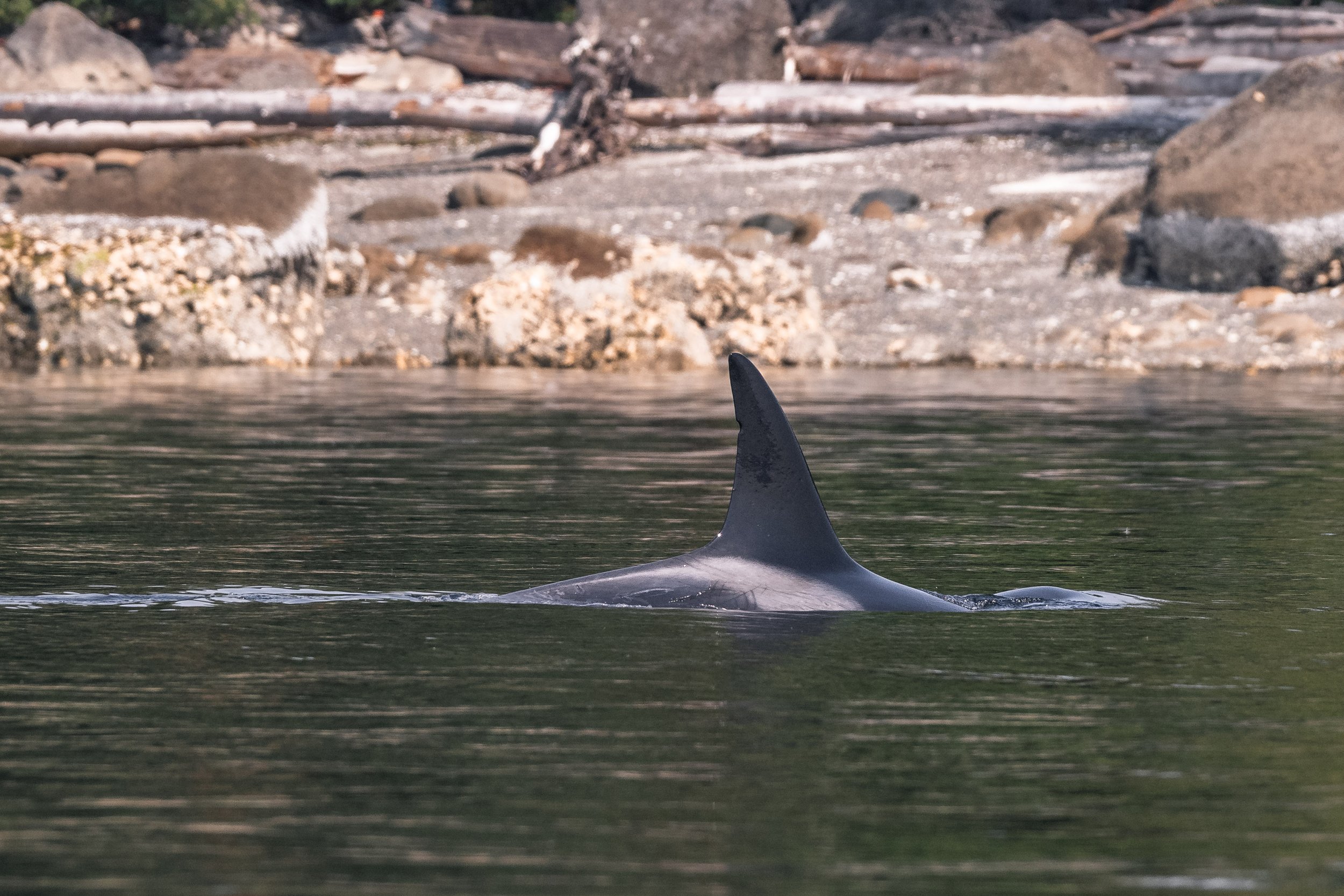
Beautiful T046B2 Akela. Photo by Aly Kohlman.
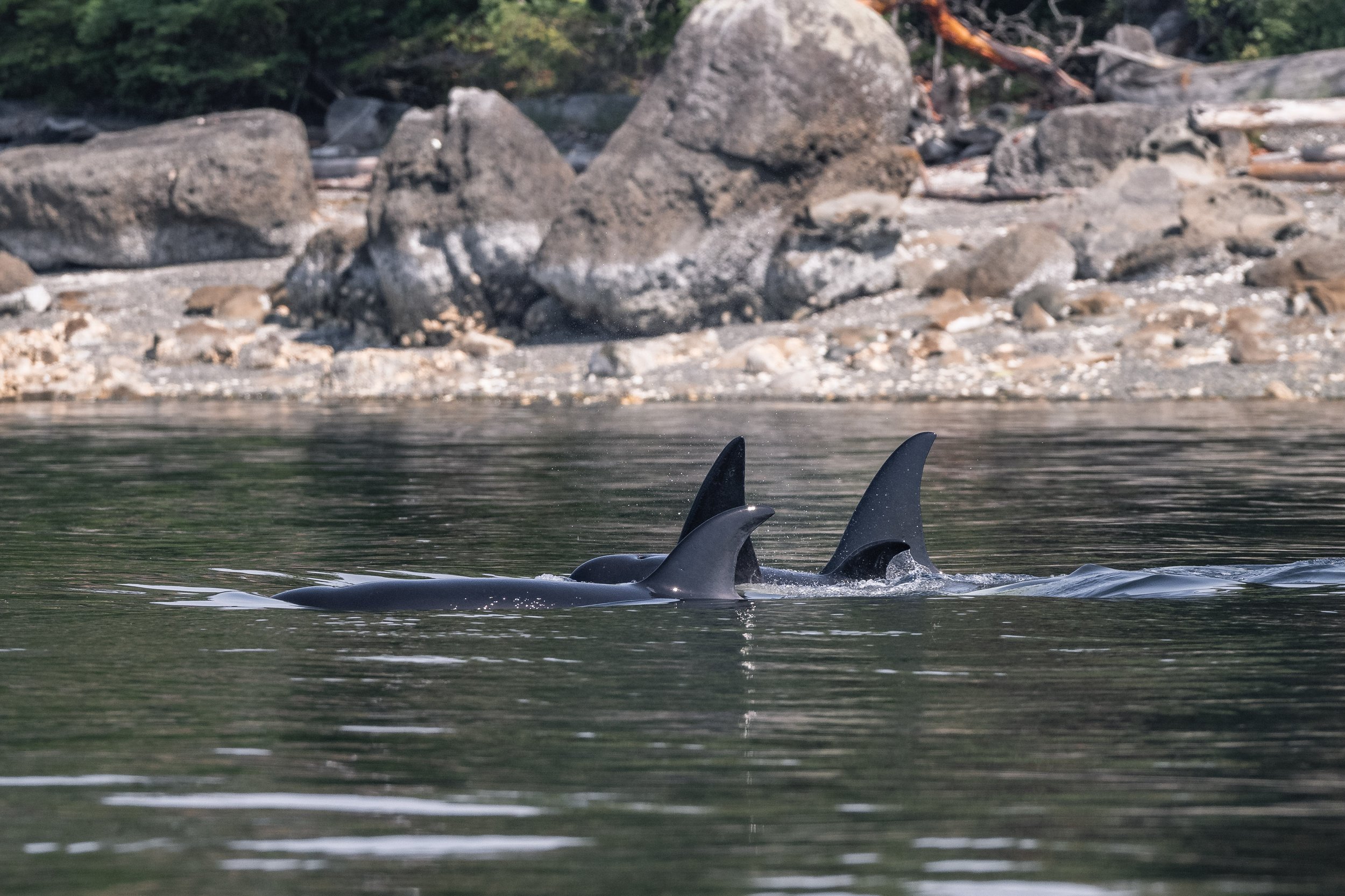
T046B2 Akela, T046B Raksha, and T046B8 Pi tucked between them. Photo by Aly Kohlman.
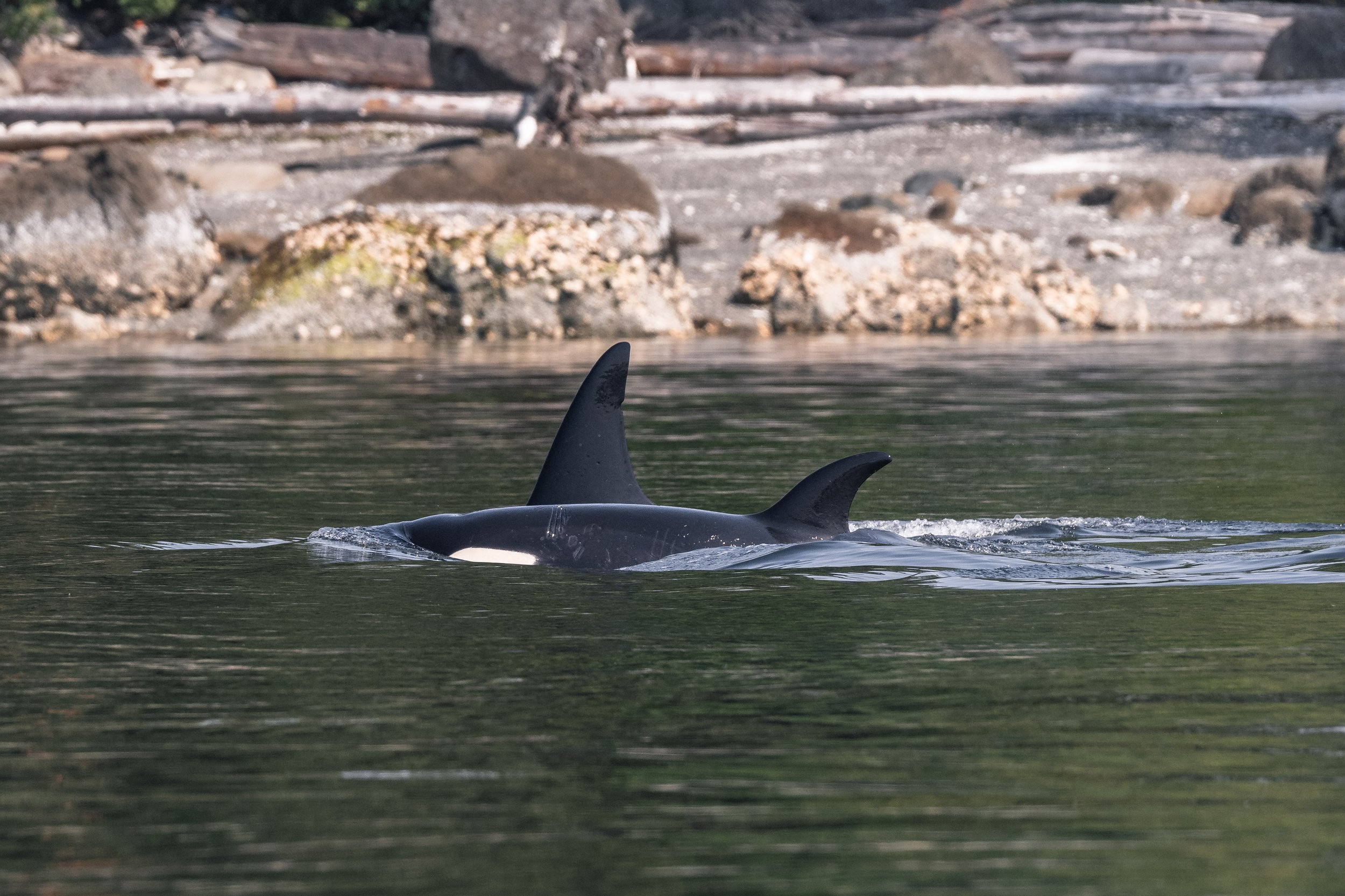
T046B2 Akela with her calf T046B2B Takaya, with many scars visible over their body. Photo by Aly Kohlman.
Other Wildlife
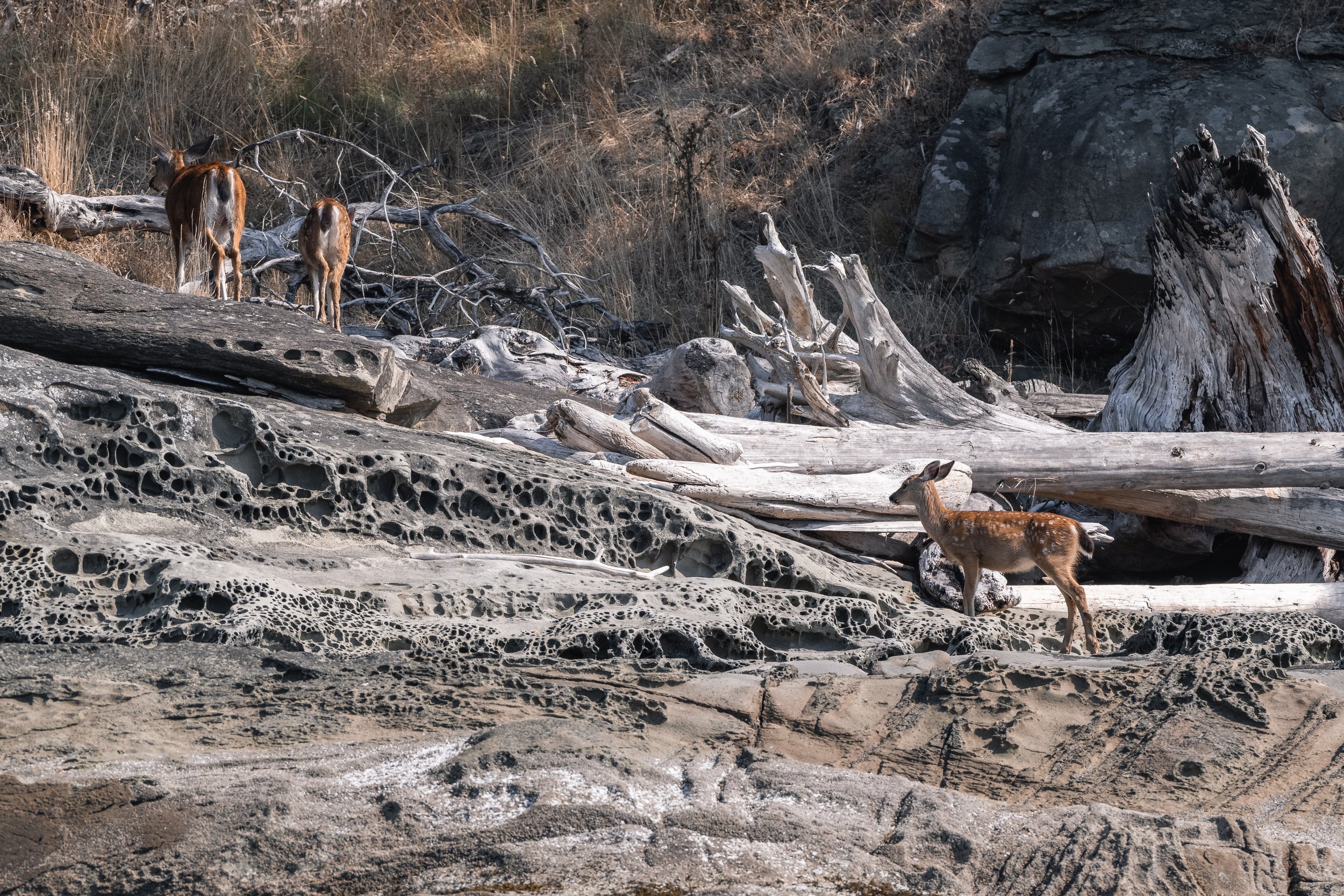
A doe with her twins! Photo by Aly Kohlman.
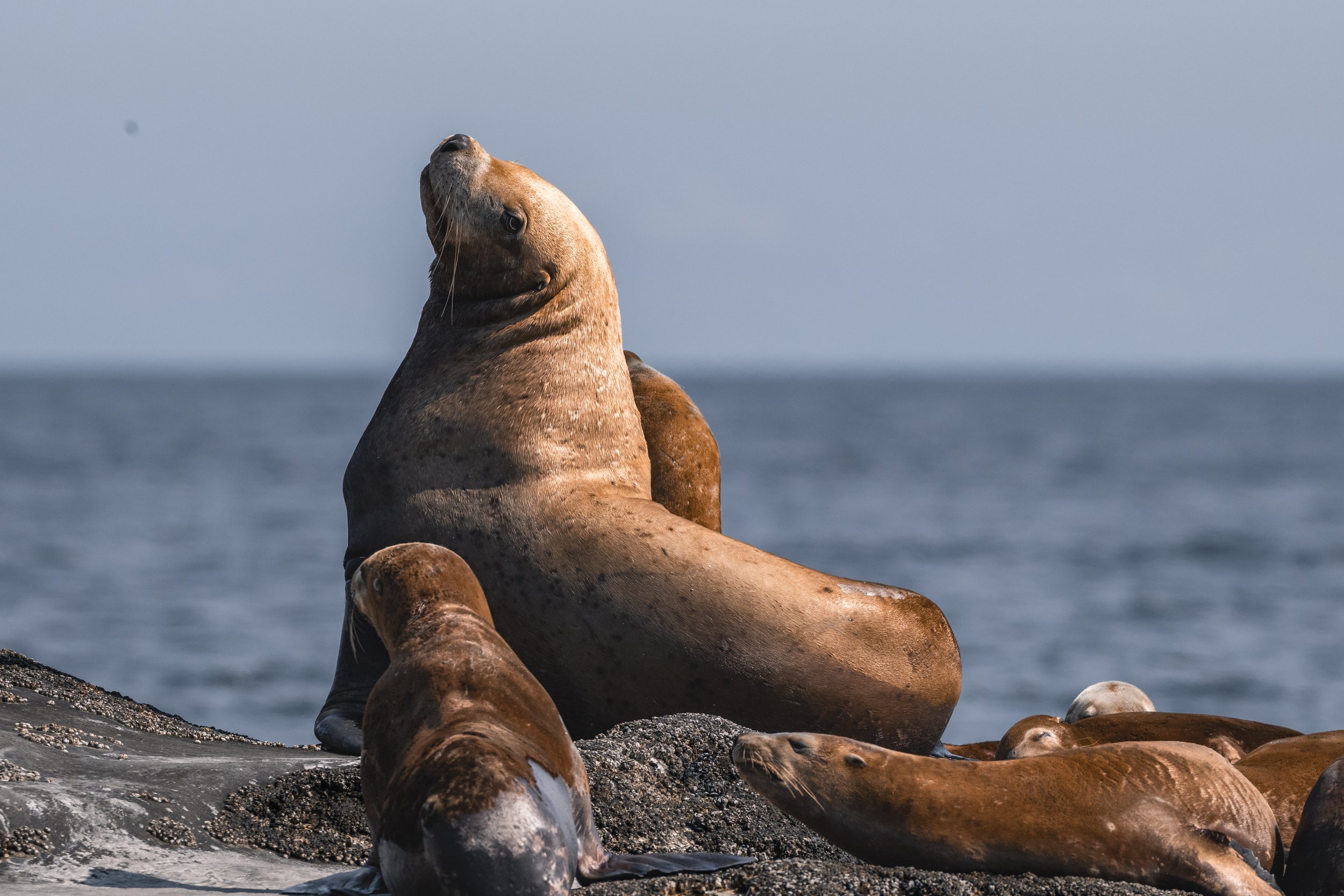
Stinky Steve at Stinky Rocks. Photo by Aly Kohlman.
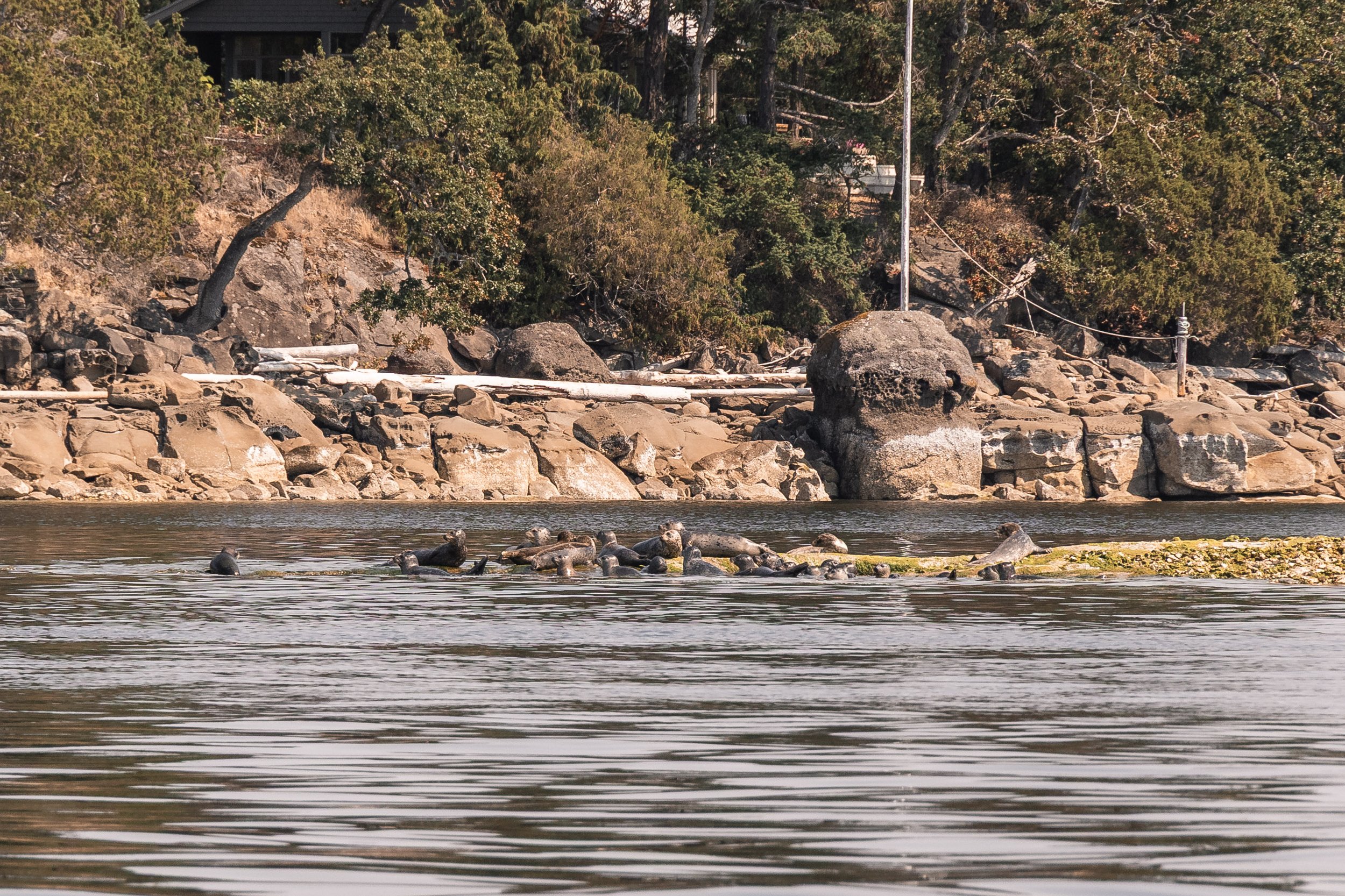
Nervous Harbour Seals watching for more potential predators. Photo by Val Watson.
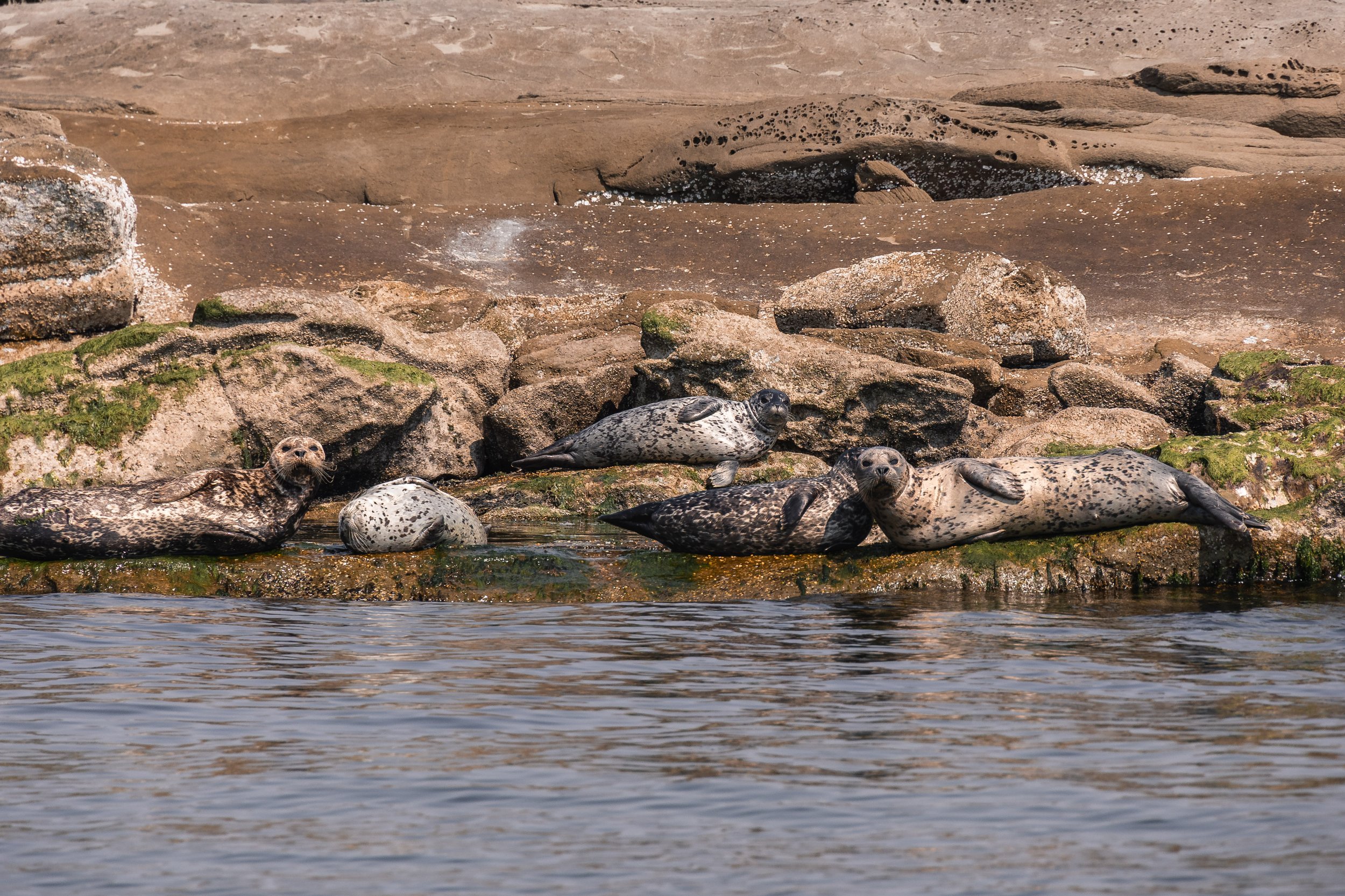
Daper little Harbour Seals all cozy on the rocks. Photo by Val Watson.
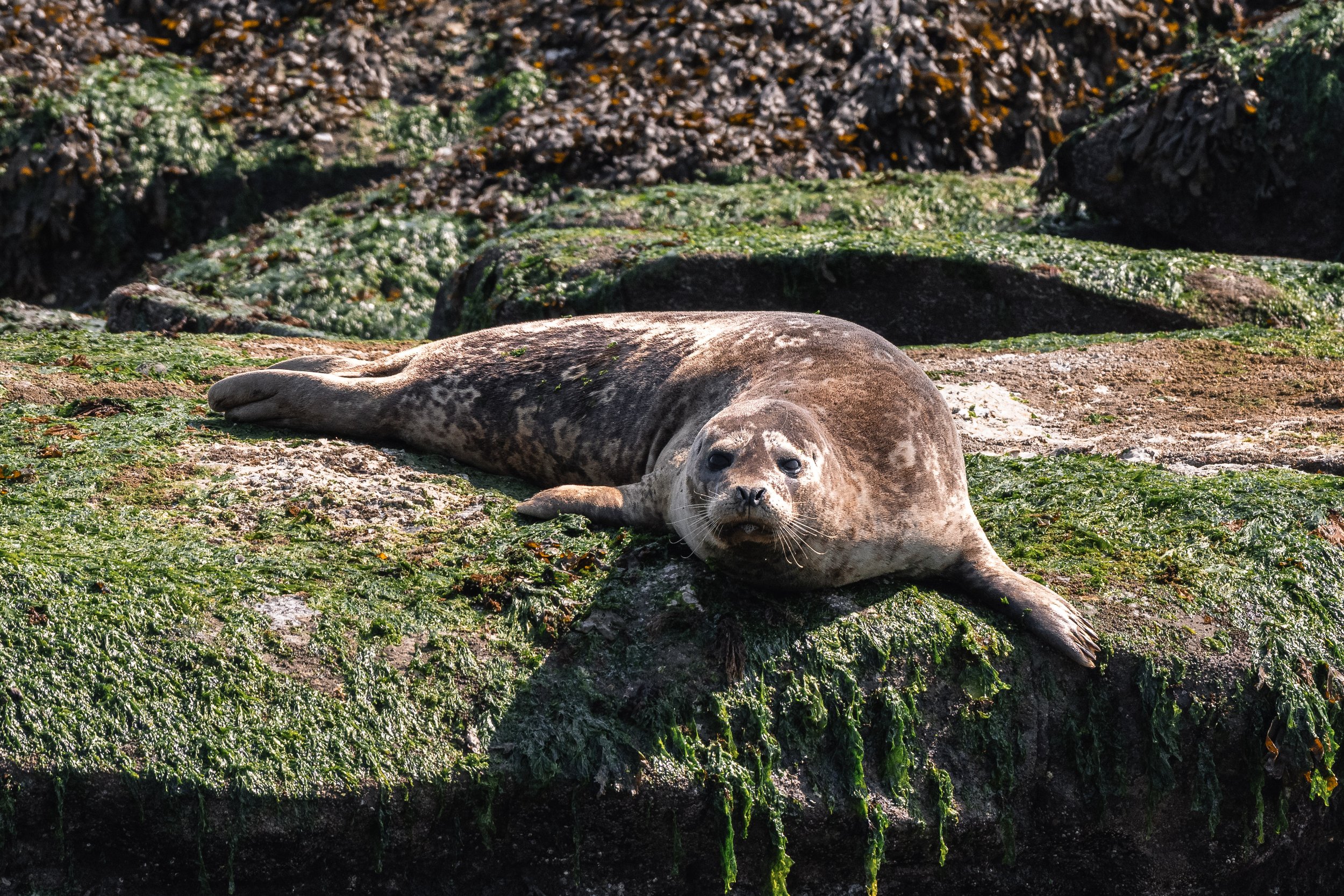
Look at how fluffy this one is! Photo by Aly Kohlman.
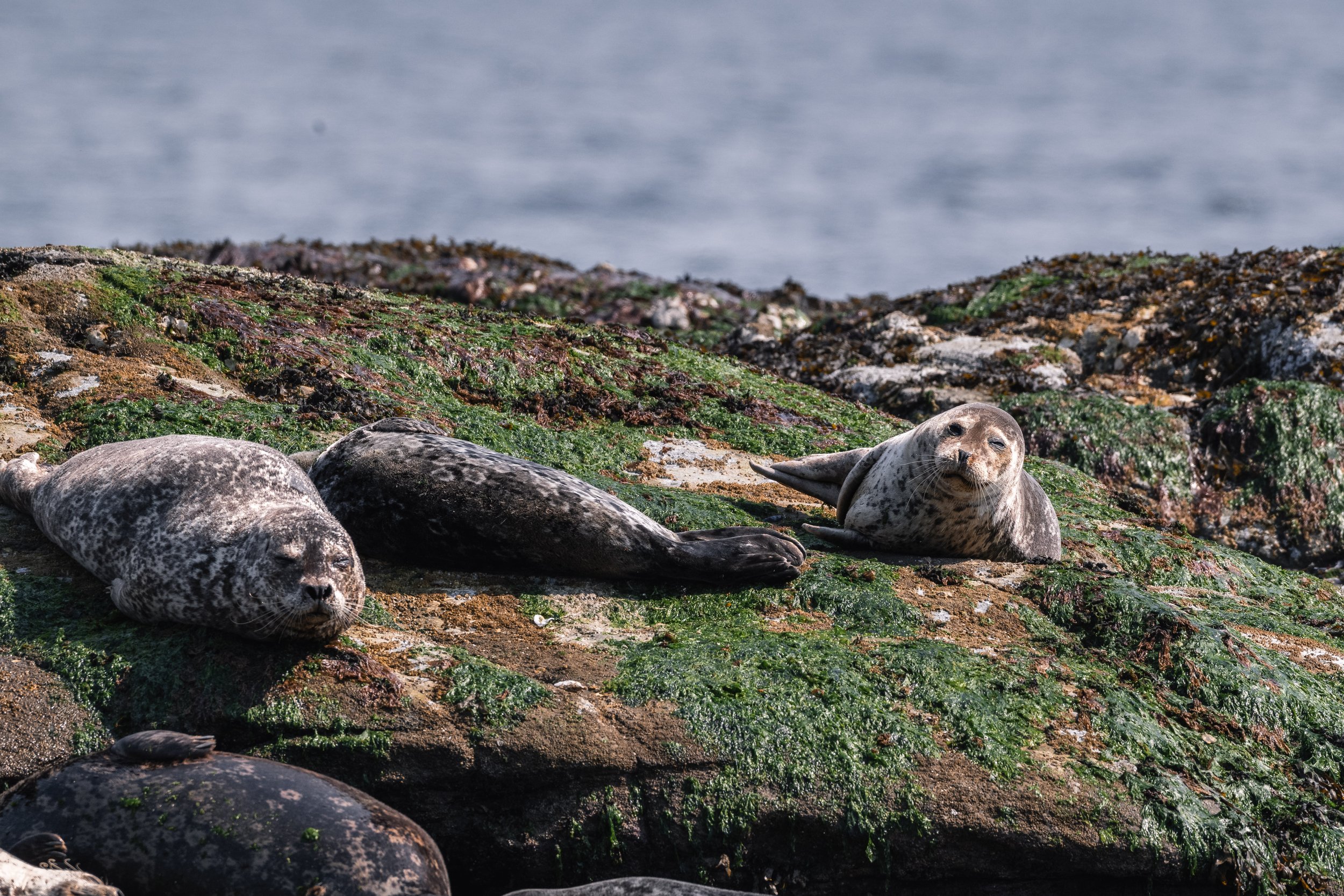
A little wink from a Harbour Seal. Photo by Aly Kohlman.
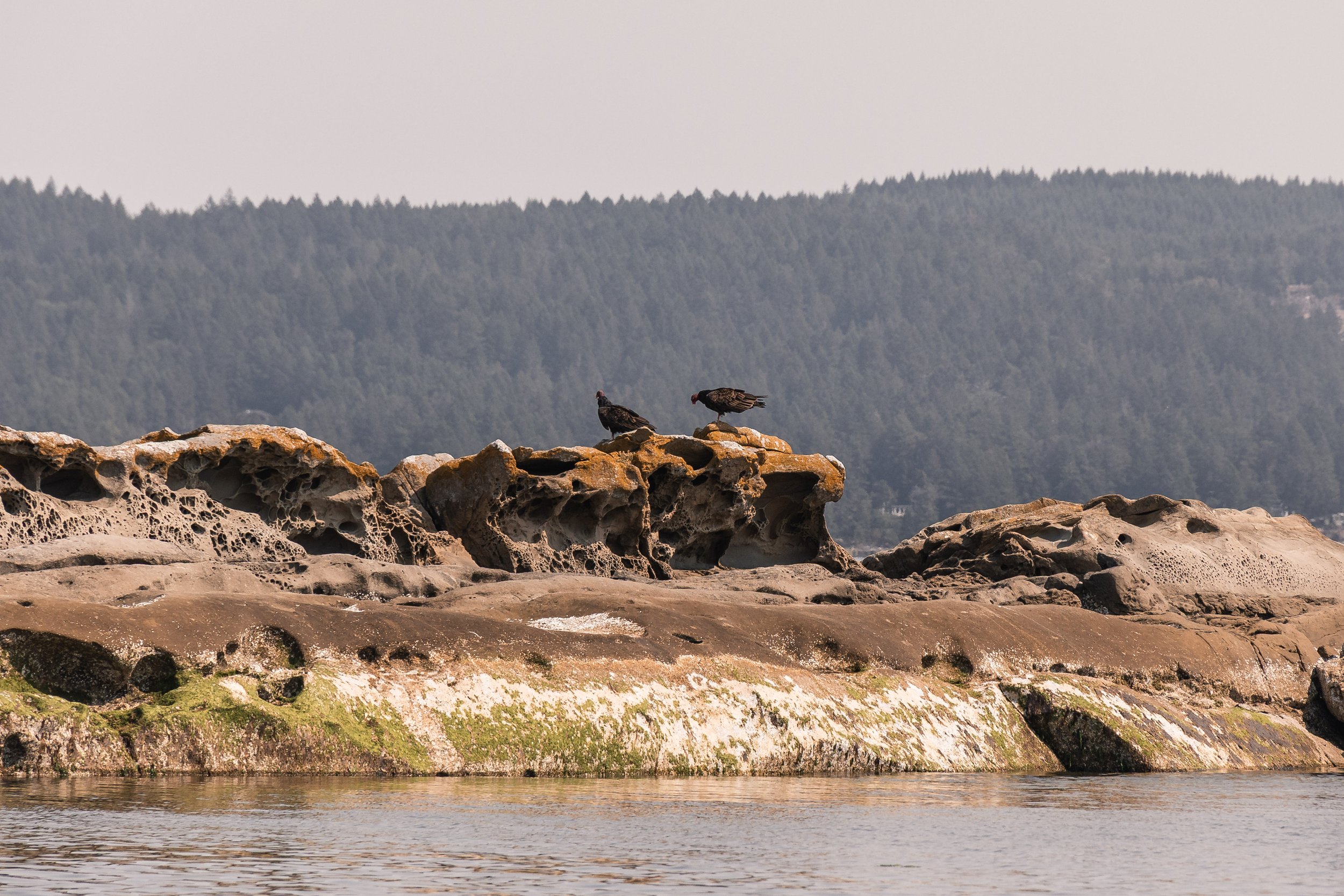
Turkey Vultures at the top of Norway Island. Photo by Val Watson.
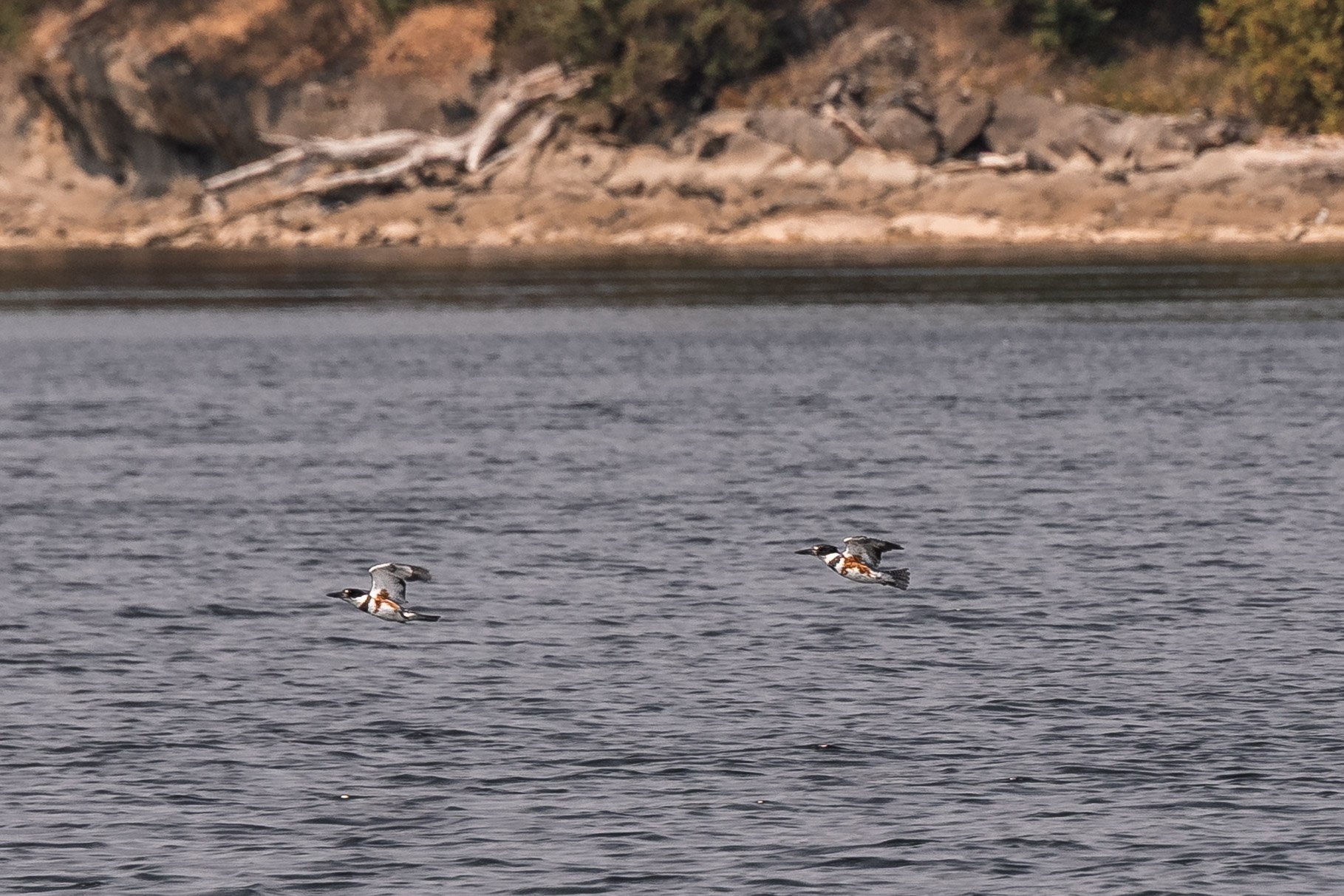
Belted Kingfishers zooming by. Photo by Val Watson.
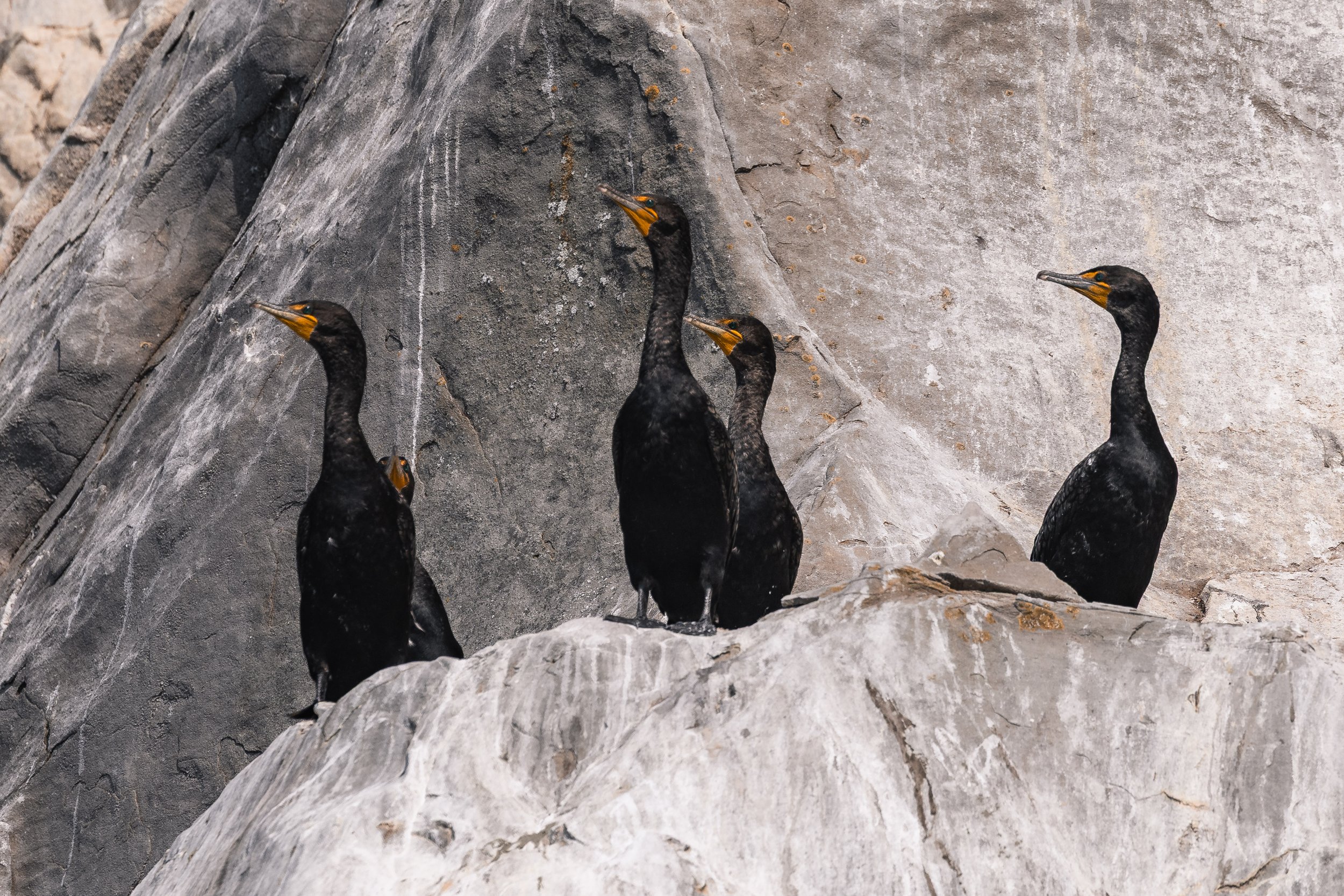
A quartet of Double-crested Cormorants. Photo by Jordan Robinson.
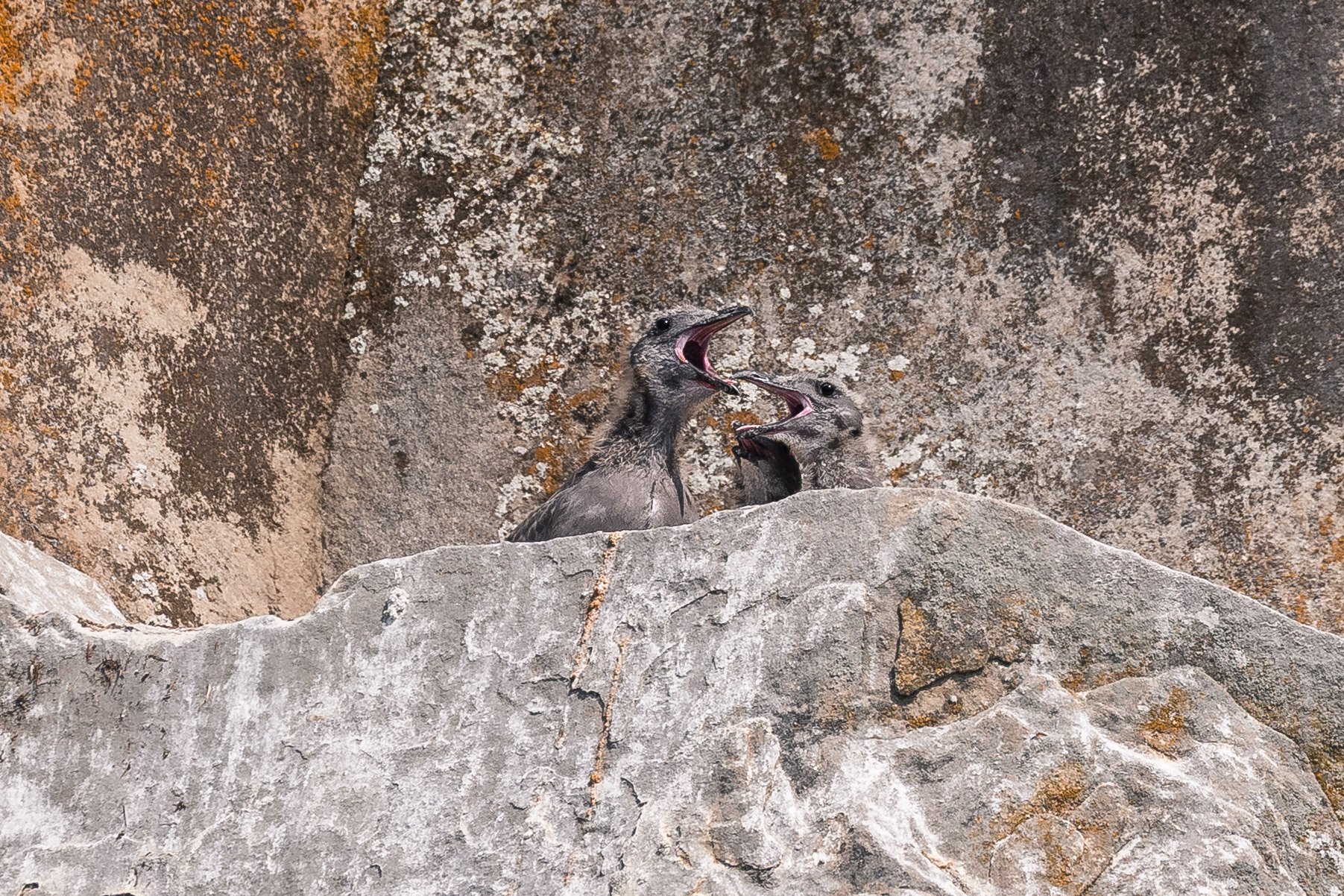
A pair of hungry hungry Gull chicks. Photo by Jordan Robinson.